Understanding Protein Synthesis: From DNA to Functional Proteins
Protein synthesis is the vital cellular process where individual cells construct proteins fundamental to various functions. Proteins make up approximately 80% of cell structure and are essential for hormones, enzymes, and cell transport. The synthesis process begins with transcription in the nucleus, where DNA is copied into mRNA. The mRNA travels to the cytoplasm, where tRNA gathers amino acids and brings them to ribosomes. rRNA then decodes the mRNA to assemble proteins. This intricate process is key to life, as proteins perform countless roles in biological systems.

Understanding Protein Synthesis: From DNA to Functional Proteins
E N D
Presentation Transcript
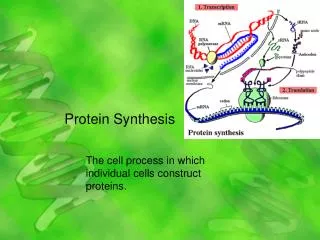
Protein Synthesis The cell process in which individual cells construct proteins.
Why do we need proteins? • Cell structure • Cells are made up of 80% proteins • Cell processes • Hormones • Enzymes • Cell transport (cell membrane)
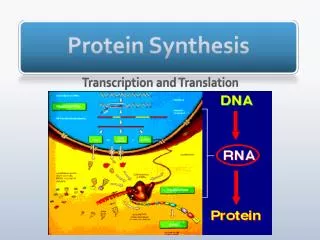
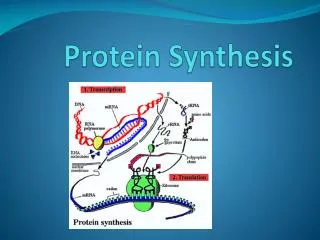
What do we need for protein synthesis? DNA contains the template for making mRNA during a process called transcription. DNA stays only in the nucleus.
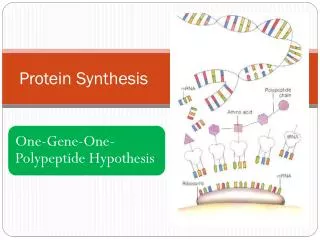
RNA • mRNA -- messenger RNA • Makes a copy of DNA and takes it into the cytoplasm. • tRNA – transfer RNA • Uses the code from mRNA and collects amino acids found in the cytoplasm and takes them to the ribosomes. • rRNA – ribosomal RNA • Uses the amino acids and makes the proteins. This occurs in the ribosomes.
Ribosomes • Site of protein synthesis.
Let’s compare protein synthesis to building a house. • Lot – where house is built • Architect- plans • Materials – wood, nails • Contractor - Uses plans to buy materials • Builders – Uses plans to build house • Final Product - House ------Ribosome -----DNA -----Amino Acids -----mRNA ----- mRNA, tRNA and rRNA -----Proteins
Process of protein synthesis • In the Nucleus - DNA – blueprint • mRNA – copies DNA – this is called transcription • Takes this copy to tRNA and rRNA • In the cytoplasm – tRNA uses mRNA’s template to collect amino acids and takes them to the ribosomes • In the ribosomes – rRNA decodes mRNA for making proteins and interacts with tRNA to make proteins. • this is called translation
What is needed for protein synthesis • Amino acids are the monomers of proteins. • Chains of amino acids make a protein. • 3 bases in a row is called a codon – amino acid • The opposite 3 bases in a row is called an anticodon.
The two steps in protein synthesis are: • Transcription- what does this mean? • Translation – what does this mean?
Transcription • DNA ►mRNA • Location = nucleus • Steps • a. Enzyme binds to DNA, unzips it • b. mRNA copy of gene made • from DNA template • *U replaces T in RNA
Translation • Steps of Translation • 1. mRNA moves to cytoplasm, • binds to ribosome • 2. tRNAanticodon brings the amino acid to the ribosome • 3. rRNA assembles the protein by reading mRNA and directing tRNA.