Cell Structure & Function
This resource explores the fundamental concepts of cell structure and function, including the cell theory, classifications of cells, and detailed descriptions of cellular organelles. Learn about prokaryotic and eukaryotic cells, their components like the nucleus, mitochondria, and chloroplasts, as well as their roles in various life processes. Ideal for students and enthusiasts seeking to understand the building blocks of life and the vital functions they perform.

Cell Structure & Function
E N D
Presentation Transcript
Cell Structure & Function http://koning.ecsu.ctstateu.edu/cell/cell.html
Cell Theory • All living things are made up of cells. • Cells are the smallest working units of all living things. • All cells come from preexisting cells through cell division.
Definition of Cell A cell is the smallest unit that is capable of performing life functions.
Examples of Cells Amoeba Proteus Plant Stem Bacteria Red Blood Cell Nerve Cell
Two Types of Cells Prokaryotic Eukaryotic
Prokaryotic • Do not have structures surrounded by membranes • Few internal structures • One-celled organisms, Bacteria http://library.thinkquest.org/C004535/prokaryotic_cells.html
Eukaryotic • Contain organelles surrounded by membranes • Most living organisms Plant Animal http://library.thinkquest.org/C004535/eukaryotic_cells.html
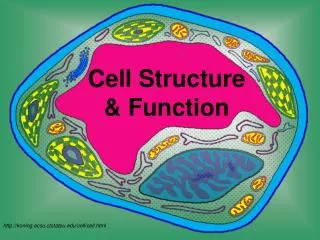
“Typical” Animal Cell http://web.jjay.cuny.edu/~acarpi/NSC/images/cell.gif
“Typical” Plant Cell http://waynesword.palomar.edu/images/plant3.gif
Cell Parts Organelles
Cell Membrane • Outer membrane of cell that controls movement in and out of the cell • Double layer http://library.thinkquest.org/12413/structures.html
Cell Wall • Most commonly found in plant cells & bacteria • Supports & protects cells http://library.thinkquest.org/12413/structures.html
Nucleus • Directs cell activities • Separated from cytoplasm by nuclear membrane • Contains genetic material - DNA
Nuclear Membrane • Surrounds nucleus • Made of two layers • Openings allow material to enter and leave nucleus http://library.thinkquest.org/12413/structures.html
Cytoplasm • Gel-like mixture • Surrounded by cell membrane • Contains hereditary material
Mitochondria • Produces energy through chemical reactions – breaking down fats & carbohydrates • Controls level of water and other materials in cell • Recycles and decomposes proteins, fats, and carbohydrates http://library.thinkquest.org/12413/structures.html
Lysosome • Digestive 'plant' for proteins, fats, and carbohydrates • Transports undigested material to cell membrane for removal • Cell breaks down if lysosome explodes http://library.thinkquest.org/12413/structures.html
Vacuoles • Membrane-bound sacs for storage, digestion, and waste removal • Contains water solution • Help plants maintain shape http://library.thinkquest.org/12413/structures.html
Chloroplast • Usually found in plant cells • Contains green chlorophyll • Where photosynthesis takes place http://library.thinkquest.org/12413/structures.html