Understanding Global Interactions (1450-1750): A Study of Empires, Cultures, and Exchanges
This comprehensive outline covers significant themes from the period of global interactions between 1450 and 1750. It evaluates the Mongol Empire's influence, explores labor systems like slavery and serfdom, and delves into cultural syncretism in the Americas. Key components include the Columbian Exchange, the Ottoman, Safavid, and Mughal Empires, and the effects of the Atlantic slave trade. Assessment methods like DBQs, timed writings, and Socratic seminars enhance student understanding of geopolitical expansion, economic changes, and cultural transformations during this transformative era.

Understanding Global Interactions (1450-1750): A Study of Empires, Cultures, and Exchanges
E N D
Presentation Transcript
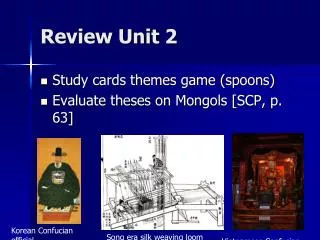
Review Unit 2 • Study cards themes game (spoons) • Evaluate theses on Mongols [SCP, p. 63] Korean Confucian official Song era silk weaving loom Vietnamese Confucian temple
Period 4: Global Interactions c. 1450 to c. 1750 • 4.1. Globalizing Networks of Communication and Exchange • 4.2. New Forms of Social Organization and Modes of Production • 4.3. State Consolidation and Imperial Expansion
Unit 4 Outline: • Mapping the Columbian Exchange and thesis analysis • Socratic Seminar on Gender: the Aztec and Inca Empires • Analyzing cultural syncretism in the Americas • Analyze changes and continuities in religions in Sub-Saharan Africa • Ottoman, Safavid and Mughal Empires DBQ
Explain the Causes of World Population Growth, 1500-1800 CE Unit #3: 1450 - 1750
Unit #3: 1450 - 1750[SCP, p. 65] Six Weeks: Encounters and Change • Week One: Encounters -- “Southernization” in Western Europe and the Scientific Revolution and Renaissance; Protestant Reformation and Catholic Counter Reformation • Week Two: Encounters and Exchange: Reconquista, Portuguese in Morocco and West Africa; Spanish in the Americas • Week Three: Encounters and Exchange: Portuguese in Indian Ocean trade networks, Manila galleons and the Ming Silver Trade • Timed writing: DBQ on Global Flow of Silver (2006 exam) • Week Four: Labor Systems in the Atlantic World -- The Africanization of the Americas (slave trade, plantation economies, resistance to slavery); Labor systems in the Russian Empire and resistance to serfdom • Timed writing: Compare labor systems (2004 exam) • Week Five: Expansion of Global Economy and Absolutism--Ottoman, Safavid, Mughal, Bourbons, Tokugawa, and Romanov Empires • Week Six: Effects of the Atlantic Slave Trade on demography in West Africa, resistance to the Atlantic slave trade, and expansion of Islam in sub-Saharan Africa • Timed writing: Change and continuity over time essay on effects of Columbian Exchange (2005 exam) • Map Quiz: Map the flow of flora, fauna, and people caused by the Columbian Exchange • Unit Test
Directions for Mapping the Columbian Exchange[SCP, p. 66]Draw an outline map of the world and then place the following items in the hemisphere of their origin: • Western Hemisphere • turkey • llama • tobacco • chocolate (cacao) • corn (maize) • squash • beans • chilies • potatoes • tomatoes Eastern Hemisphere cows sheep pigs horses wheat rice cotton silk sugar coffee measles small pox chicken pox influenza bubonic plague • Draw lines showing where the items went (they all should travel to the other hemisphere, except for llamas). • Paste index cards or sticky notes with annotations on the map explaining the effects of the plants and animals transferred across the world as a result of the Columbian Exchange • Write a thesis statement describing the changes and continuities that resulted from the Columbian Exchange
Creating New Cultures in the Americas [scp, p. 72] • Religious Change in Latin America In Mexico today, there is a holiday known as the Day of the Dead or El Día de los Muertos • Syncretism in Latin American Music
The Islamic Empires in the 16th & 17th Centuries • DBQ on training wheels [scp, p. 76]
Essay Question: “Compare the development of empire-building from 1450 – 1750 in two of the following empires: Spanish, Ottoman, and/or Russian”[SCP, p. 81] By the way, who are these guys? How do you know?
By the way, who are these guys? How do you know? Suleiman the sultan of the Ottoman Empire from 1520-66. Phillip II, king of Spain, 1527 - 1598 Peter, tsar of Russia from 1682 to 1725.