Understanding Enzymes: Biological Catalysts Driving Chemical Reactions
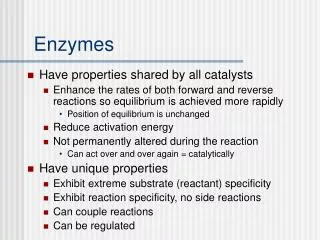
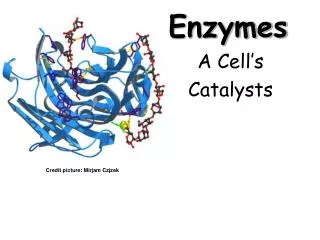
Enzymes are essential proteins that act as biological catalysts, accelerating chemical reactions without being consumed in the process. By lowering the activation energy required for reactions, enzymes facilitate metabolic processes vital for life. Each enzyme is specific to a substrate, fitting together like a lock and key. They are effective at optimal temperatures and pH ranges, but extreme conditions can alter their shape and function. Various types of enzymes exist, including digestive enzymes and those that combat harmful substances in the body.

Understanding Enzymes: Biological Catalysts Driving Chemical Reactions
E N D
Presentation Transcript
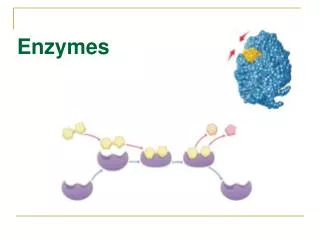
Enzymes Enzymes are proteins that speed up biological chemical reactions without themselves being used up in the process. Thus they are biological catalysts. They can be used over and over and over again.
All chemical reactions involve a change in energy. Either energy needs to be put into a reaction to make it go, which is called an endothermic reaction, or energy is released, which is called an exothermic reaction.
All reactions need an input of energy just to get it started. This energy is called the activation energy.
Enzymes work by lowering the activation energy, making it easier to start the reaction.
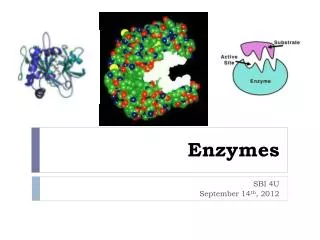
An enzyme fits its substrate like a lock fits a key. An enzyme will work with only one type of substrate.
Enzymes are not changed when they catalyze reactions. Therefore they can be used over and over and over again.
There are many different types of enzymes in living organisms. Digestive enzymes break down the food you eat. Enzymes in your tears kill bacteria. There is an enzyme in your blood which breaks down the dangerous chemical hydrogen peroxide (H2O2).
Enzymes work best at certain temperatures. If enzymes get too hot or too cold the shape will change and the active site will be unable to bind the substrate. The reaction will not proceed. pH is also critical. Enzymes only work within a small range of pH. amount of substrate will change the rate of enzyme activity.