
GBAS Frequency Planning Criteria Presentation
E N D
Presentation Transcript
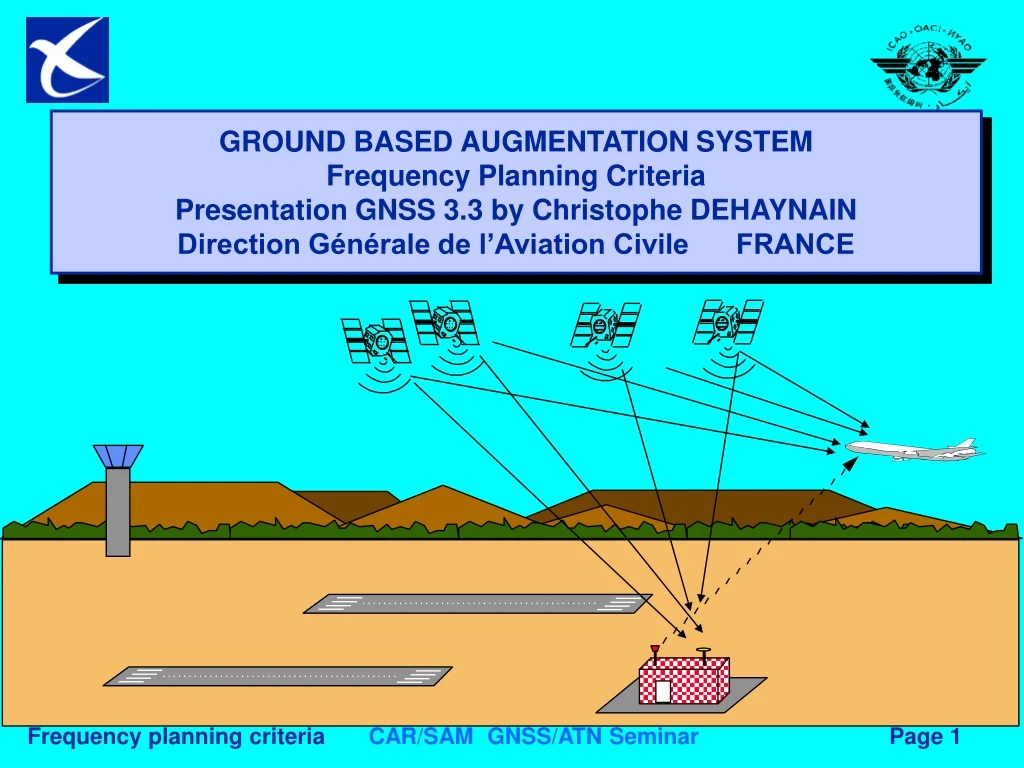
GROUND BASED AUGMENTATION SYSTEMFrequency Planning CriteriaPresentation GNSS 3.3 by Christophe DEHAYNAIN Direction Générale de l’Aviation Civile FRANCE
GROUND BASED AUGMENTATION SYSTEMPresentation Overview • GBAS principle • Why do we need frequency planning criteria ? • How the ICAO criteria have been established ? • What are the current criteria ? • What has still to be done ?
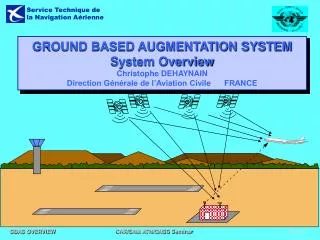
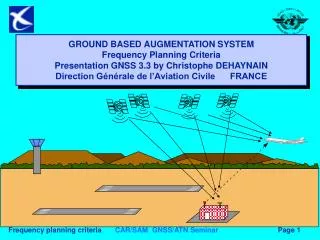
GBAS principle • The Ground Based Augmentation System is composed of 3 segments : • the space segment (GPS, GLONASS, GALILEO satellites) • the ground segment (GBAS ground station) • the airborne segment (the users equipment)
GBAS principle • Objective of the Data Link: • interface between the ground and the airborne segments • Type of transmitted information: • Pseudo Range Corrections (high rate) • Integrity parameters (,B values) (high rate) • Final Approach Segments description (low rate)
ICAO GNSSP choice • ICAO GNSS Panel validated in June 2000 the VHF D8PSK data Link among five considered options : • VHF Nav. 108-117.975 MHz • D8PSK modulation • GFSK modulation • DME UHF band (960-1215 MHz) • GPS L1 band (1575.42 MHz) • C band (5030-5150 MHz)
ICAO GNSSP choice • VHF Navigation band (108-117.975 MHz) • 25 KHz channel spacing • horizontal polarisation (possibility to have vertical also) • D8PSK modulation • 31.5Kbit/s rate • TDMA (Time Division Multiple access) : 8 slots per 0.5 s frame
Why do we need frequency planning criteria ? • GBAS Data Link will use Navigation VHF Band frequencies (108 - 118 MHz) • This frequency band is already used for VOR and ILS localizer assignations • GBAS, ILS and VOR will coexist during a transition phase • The three services need to be protected from mutual interference
How the ICAO criteria have been established ? • Determination of minimum Desired/Undesired signal ratio at which VOR receiver is jammed by GBAS transmission on co- and adjacent channels (and vice- versus) • Use of the GNSS SARPS to determine the minimum Desired/Undesired signal ratio at which GBAS is jammed by VOR or GBAS transmission on co- and adjacent channels • Computation of minimum geographical distance between co- and adjacent VOR/GBAS and GBAS/GBAS channels transmitters
Determination of minimum Desired/Undesired signal ratio at which VOR receiver is jammed by GBAS transmission on co- and adjacent channels VOR/ILS desired signals VOR/ILS receiver under test ILS/VOR indicator VDB undesired signals
Computation of minimum geographical distance between co- and adjacent VOR/GBAS channels transmitters Dw VOR protected volume GBAS protected volume Dvor DGBAS GBAS VOR Dac Minimum separation
Computation of minimum geographical distance between co- and adjacent VOR/GBAS channels transmitters (2) Dac, Dw in km Fdoc in microvolts/meter
What has still to be done ? • Compatibility criteria for • ILS Localizer and GBAS in the band 108 - 112 MHz have still to be defined (ICAO objectives : 2004-2005) • VHF AM Communications and GBAS have still to be defined (ICAO objectives : 2004-2005) • VHF VDL Mode 4 and GBAS have still to be defined (ICAO objectives : 2004-2005) • Compatibility criteria for elliptical polarised GBAS signals need to be defined (No ICAO plan) • Before these criteria are defined, GBAS Data-link frequencies have to be assigned in a limited band (112.025 - 116.400 MHz)


![Satellite-based GNSS Augmentation System Market: [2023-2035]](https://cdn7.slideserve.com/12311638/satellite-based-gnss-augmentation-system-market-dt.jpg)