Contraception
This chapter provides an in-depth exploration of various modern contraceptive methods aimed at preventing conception and protecting against sexually transmitted diseases. It covers the physiological principles of reproduction, different types of contraception including barrier, hormonal, natural, and surgical methods, as well as their advantages, disadvantages, effectiveness, and failure rates. Key methods such as oral contraceptives, IUDs, condoms, and fertility awareness are discussed, offering insights into their use and implications for reproductive health.

Contraception
E N D
Presentation Transcript
Contraception Chapter 6
Contraceptives • Definition: • Conception: the fusion of an ovum and sperm that creates a fertilized egg. • Contraception: Preventing conception by blocking the female’s egg from uniting with the male’s sperm, thereby preventing pregnancy. • Modern contraception are much more predictable and effective than in the past. • Many play a role in the prevention against sexually transmitted diseases
Principles of Contraception • Based on the physiology of reproduction. • Ovulation: the release of the egg. • Types of contraception: • Barrier, Hormonal, Natural Methods, and Surgical • Factors affecting choice • Advantages and disadvantages • Effectiveness • Contraceptive failure rate • Continuation rate
Oral contraceptives (OCs): “The Pill” • Estrogen and progesterone taken orally • Mimics the hormonal activity of the corpus luteum • Corpus luteum secretes high levels of progesterone and estrogen to suppress ovulation. • Combination pill • Most common • 1-month packet containing estrogen and progetin • Extended-cycle pill • Lybrel • “Minipill” • Advantages • Disadvantages • Side effects • Effectiveness:
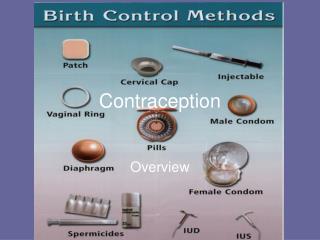
Contraceptive Skin Patch • Thin 13/4 inch square patch • Releases estrogen and progestin slowly into the bloodstream. • Prevention the same way as OCs • Worn for 1 week, replaced on the same day for 3 consecutive weeks. Fourth week no patch • Advantages • Disadvantages • Effectiveness
Vaginal Contraceptive Ring • The NuvaRing • Resembles the rim of a diaphragm and is molded with progestin and estrogen • 2 inch ring slowly releases the hormones • During fourth week, remove the ring and use a new ring after the fourth week. • Advantages • Disadvantages • Effectiveness
Contraceptive Implants • Implanon(2006) • Hormonal method • Single implant • Effective for 3 years • Inhibits ovulations and affects the development of the uterine lining. • Advantages • Disadvantages • Side effects • Effectiveness:
Injectable Contraceptive • Depo-Provera • Hormonal treatment • Injectable progestin every 12 weeks • Advantages • Disadvantage • Side effects • period will subside - ovaries will not release egg • It may take 12 months before cycle will return • Effectiveness
Emergency Contraceptive • Postcoital Pill, Morning After Pill, Plan B (OTC) • Use a EPT kit • Most common is the two dose regimen • Prevents uterine implantation • Needs to be taken within 72 hours. Best used within 24 hours • 2006 – FDA approved Plan B as a OTC • Intrauterine Device
Intrauterine Device (IUD) • T-380A (ParaGard) 10 years of protection • Copper • Levonorgestral (Mirena) 5 years of protection • Release small amounts of progestin • Not exactly sure how it prevents pregnancy • Advantages • Disadvantages • Effectiveness
Male Condoms • Thin latex sheaths • Protection against STD’s • Advantages • Disadvantages • Effectiveness • Use with spermicide
Female Condom • Reality Brand • Polyurethane sheath with two flexible rings • Advantages • Disadvantage • Effectiveness
The Diaphragm with Spermicidal jelly or cream • Dome shaped cup of thin rubber stretched over a collapsible metal ring. • Custom fit • Following intercourse • Advantages • Disadvantages • Toxic shock syndrome (TSS) • Effectiveness
Lea’s Shield • One-size-fits-all diaphragm-like device • Available by prescription • Can be used by women allergic to latex • Advantages • Disadvantages • Effectiveness
FEMCap • Small rubber or plastic cap • Must use foam kit • Advantages • Disadvantage • Effectiveness
Contraceptive Sponge • Round, absorbent device about 2 inches in diameter • Presaturated with the same spermicide that is used in contraceptive creams and foams • Advantages • Disadvantages • Toxic shock syndrome (TSS) • Effectiveness
Vaginal Spermicide • Foams, creams, jellies • Spermicidal suppository • Vaginal Contraceptive Film (VCF) • How it works • Must wait 6 hours post if the women wants to douche. • Advantages • Disadvantages • Effectiveness
Abstinence, Fertility Awareness, and Withdrawal • Abstinence • Without intercourse or sexual activities • Benefits: more self respect and respect for others. Security that you are being pursued for sexual reasons. Less worry about STDs and Pregnancy.
The Fertility Awareness Method (FAM) • FAM • Calendar method • Temperature method • Mucus method • Withdrawal • Coitus interrutus • Combining methods
Male Sterilization: Vasectomy • Severing of the vas deferens • May return to work in 2 days • Semen tested in 12 weeks or 20 ejaculations • Reversal varies between 80% to 50%, depending on the report. • Complication rate • Effectiveness
Female Sterilization • Tubal sterilization (laparoscopy) is most common also know as tubal ligation • Essure system (2002) • Tiny spring-like metallic implants causing scarring blocking the Fallopian tubes • Hysterectomy • Surgical cases • Complication rate • Reversibility
Issues in Contraception • When is it Okay to Begin Having Sexual Relations? • Society’s approach • Changing of attitudes with the changing of time. • Answering personal questions. • Contraception and Gender Differences • Sexuality and Contraception Education for Teenagers
Which Contraceptive Method is Right for You? • Appropriate method of birth control • Health risks • Implications of unplanned pregnancy • STD risk • Convenience and comfort level • Type of relationship • Ease and cost of obtaining and maintaining each method • Religious or philosophical beliefs
Contraception Chapter 6