
Understanding Congruence and Similarity in Polygons: A Comprehensive Guide
E N D
Presentation Transcript
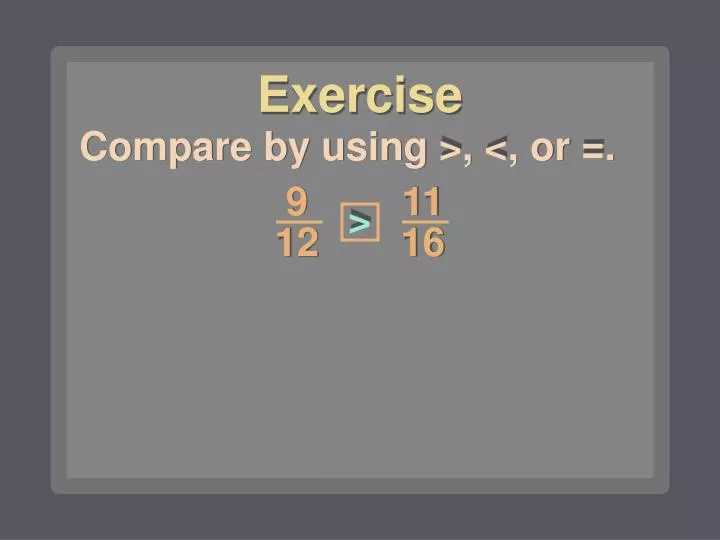
Exercise Compare by using >, <, or =. 912 1116 >
Exercise Compare by using >, <, or =. 1218 812 =
Exercise Compare by using >, <, or =. 1628 1321 <
Exercise Solve the proportion. x15 1612 = x = 20
145 45 d = = 2 = 2.8 Exercise Solve the proportion. 57 2d =
Congruent Polygons • Congruent polygons are polygons with the same size and shape.
C • F • A • B • D • E
same place in different figures • corresponding angles • corresponding sides
Congruent Angles • Congruent angles are angles with the same measure.
Congruent Segments • Congruent segments are segments with the same length.
AD • BE • CF • Corresponding Angles • Corresponding angles are congruent (have the same measure).
C • F • A • B • D • E
ACDF • ABDE • BCEF • Corresponding Sides • Corresponding sides are congruent (have the same length).
X Example 1 RSTXYZ. Complete each statement. S Y R T Z X R
Y Example 1 RSTXYZ. Complete each statement. S Y R T Z X S
Z Example 1 RSTXYZ. Complete each statement. S Y R T Z X T
XZ Example 1 RSTXYZ. Complete each statement. S Y R T Z X RT
XY Example 1 RSTXYZ. Complete each statement. S Y R T Z X RS
YZ Example 1 RSTXYZ. Complete each statement. S Y R T Z X ST
Similar Polygons • Similar polygons are polygons that have the same shape but not necessarily the same size. The symbol ~ means “is similar to.”
Theorem • If two polygons are similar, then the corresponding angles are congruent and the lengths of the corresponding sides are proportional.
AD • BE • CF B • Corresponding Angles 9 6 12 A C E 6 4 D 8 F
ABDE • ACDF • BCEF B • Corresponding Sides 9 6 12 A C E 6 4 D 8 F
ABDE • 6 4 • 3 2 = = • ACDF • 12 8 • 3 2 = = • BCEF • 9 6 • 3 2 = =
scale factor—ratio of corresponding dimensions in similar figures
Example 2 RST ~ XYZ. Use a proportion to find XY. Y S 10 15 9 X 12 Z 18 R T
XZRT • XYRS = • XY9 • 2 3 = • 3 • 3 • 3(XY) = 18 XY = 6
FD • ABFE = Example ABC ~ FED. Complete the ratio. D C 8 6 A F B E AC
Example ABC ~ FED. If BC = 9, what is ED? D C 8 6 A F B E 12
Example ABC ~ FED. If the perimeter of ABC is 30, what is the perimeter of FED?
D C 8 6 A F B E 40
Example ABC ~ FED. If mA = 85° and m E = 30°, what is the mC? D C 8 6 A F B E 65°
Example Are PQR and JKL similar? L Q 8 6 18 J 12 P 12 8 K no R
Example What length of PQ would make them similar? L Q 8 6 18 J 12 P 12 8 K 9 R
Example Assume the two parallelograms are similar. 12 B C F G 9 6 A D E FG = 8
Example Assume the two parallelograms are similar. 12 B C F G 9 6 A D E AE = 4
Example If the diagonal AC = 15, what is the length of EG? 12 B C F G 9 6 A D E 10
Example What is the perimeter of EFGD? 12 B C F G 9 6 A D E 28
![[Exercise Name] Functional Exercise](https://cdn0.slideserve.com/621913/exercise-name-functional-exercise-dt.jpg)
![[Exercise Name] Functional Exercise](https://cdn1.slideserve.com/1717560/exercise-name-functional-exercise-dt.jpg)

![[Exercise Name] Functional Exercise](https://cdn3.slideserve.com/6680259/exercise-name-functional-exercise-dt.jpg)
![[Exercise Name] Tabletop Exercise](https://cdn4.slideserve.com/9191716/exercise-name-tabletop-exercise-dt.jpg)