Evaluation Benchmarking in Public Sector: Insights from Multiple Development Banks
This document presents an evaluation benchmarking exercise prepared by K. Chomitz for the ECG meeting on October 25, 2013. It includes submissions from various development banks such as the African Development Bank, Asian Development Bank, and World Bank. Key aspects discussed include evaluation strategies balancing accountability and learning, stakeholder consultation processes, performance evaluation reports, and methodologies used to assess project outcomes. The report also highlights frequently and infrequently implemented evaluation elements, offering insights for improving the effectiveness of evaluation practices across institutions.


Evaluation Benchmarking in Public Sector: Insights from Multiple Development Banks
E N D
Presentation Transcript
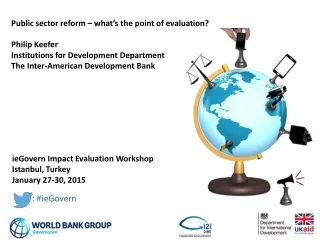
Public sector evaluationbenchmarking exercise Prepared for ECG Meeting by K Chomitz for IEG October 25 2013
Submissions received from CEDs at: • African Development Bank • Asian Development Bank • Council of Europe Bank • European Investment Bank • Interamerican Development Bank (note: practices currently under revision) • IFAD • Islamic Development Bank • World Bank
Distribution of responses Note: excludes IADB – system under revision
Elements most frequently implemented(7 CEDs fully consistent) • The CED has a strategy for its mix of evaluation products that balances the two evaluation functions of accountability and learning. • Review: Draft evaluations are reviewed to ensure quality and usefulness.
Elements frequently implemented(6 CEDs fully consistent) • Performance Evaluation Reports (PERs): PERs are scheduled to ensure that sufficient time has elapsed for outcomes to be realized and for the sustainability of the operation to be apparent. • Stakeholders’ Consultation: Stakeholders are consulted in the preparation of evaluations. • Scope of Evaluation: Evaluations encompass all performance attributes and dimensions that bear on the operation’s success. • The assessment of Relevance covers both the relevance of objectives and the relevance of project design • The assessment of IFI Performance covers the quality of services provided by the IFI during all project phases. • Borrower Performance assesses the adequacy of the Borrower’s assumption of ownership and responsibility during all project phases. • Rules for assigning criteria ratings are clearly spelled out.
Elements infrequently implemented(two CEDs fully consistent) • The evaluation includes consideration of unanticipated outcomes. • If project objectives were revised during implementation, the project is assessed against both the original and the revised objectives. • The CED prepares a periodic synthesis report • The CED follows up on IFI Management’s implementation of recommendationsmade by the CED
Elements least implemented(only one CED fully consistent) • Sampling Methodology: The sampling methodology and significance of trends are reported. (IFAD) • Efficiency: : (i) Did the benefits of the project exceed project costs; and (ii) Were the benefits of the project achieved at least cost? (ADB)
Questions for discussion • Do these results align with expectations? • Are there OPs or EEs which need to be revisited? • Do you agree that the next step is validation to ensure consistency with GPs? • Is there scope for sharing approaches to GPs?