Decoding Atomic Models: Electron Arrangement & Light Energy
Learn about the intricate arrangement of electrons in an atom, the role of electromagnetic radiation energy, and the evolution from Bohr to Quantum Mechanical models. Explore how electrons exhibit wave-like properties challenging traditional particle concepts. Uncover the significance of wave functions in determining electron energy states and densities. Delve into the complexity of electron behavior and the Heisenberg Uncertainty Principle.

Decoding Atomic Models: Electron Arrangement & Light Energy
E N D
Presentation Transcript
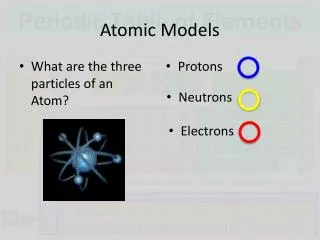
Atomic Models • Scientist studying the atom quickly determined that protons and neutrons are found in the nucleus of an atom. • The location and arrangement of the electrons was more elusive. • Understanding the arrangement of the electrons in an atom is important because the electrons are involved in the formation of ions and compounds.
Atomic Models • Elements in the same group exhibit similar chemical and physical properties. • Alkali Metals: • Very reactive • Form cations with +1 charge • Halogens: • Form anions with -1 charge • Noble Gases • Inert (unreactive) • Do not form ions • Why?
Atomic Models • The properties and reactivity of an element depends on its electronic structure. • The arrangement of electrons in an atom • Number of electrons • Distribution of electrons around the atom • Energies of the electrons • Much of our knowledge of electronic structure came from studying the way atoms absorb or emit light.
Atomic Models • Light is a type ofelectromagnetic radiation • a form of energy with both electrical and magnetic components Wavelength(l) the distance between successive peaks Frequency (u) the number of complete wavelengths that pass a given point in 1 sec
Atomic Models • The wavelength and frequency of electromagnetic radiation are inversely proportional:
Atomic Models • The energy of light is directly proportional to its frequency: E = h u where h = Planck’s constant = 6.626 x 10⁻³⁴ J.s • and inversely proportional to its wavelength: E = hc l
Atomic Models The electromagnetic spectrum: Low E High E
Bohr Model • Two models are used to explain the arrangement of the electrons in atoms. • Bohr model • Nice “picture” but incorrect! • Explains only 1 electron systems • Quantum mechanical model • Hard to visualize but the best model we have!
High voltage H2 Bohr Model • When an electrical current is passed thru a sample of H2 (g), light with certain specific wavelengths is emitted (instead of a continuous “rainbow” of colors). Atomic line spectrum
Bohr Model • Niels Bohr developed a model that explained the line spectrum formed by hydrogen. • Observations: • Only certain wavelengths of light are emitted. • Since E = hc/l, only light with certain specific energy is emitted.
Bohr Model • Bohr explained the line spectrum of hydrogen by assuming that the energy of an electron is quantized. • Restricted to certain values
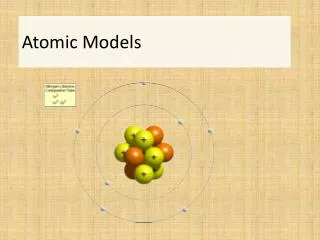
Bohr Model • According to Bohr: • Electrons are confined to specific energy states called orbits. • Only orbits of specific radii are allowed. • An electron in an allowed orbit has a very specific energy.
Bohr Model • An electron in the ground state (the lowest energy state) can move to a higher energy orbit by absorbing energy. • An electron in the excited state (a higher energy state) emits energy as a photon (a packet of light) when it falls back to a lower energy level. • The light emitted has a wavelength that corresponds to the energy difference between the two orbits.
Bohr Model • The Bohr model effectively explains the line spectra of atoms and ions with a single electron • H, He+, Li2+ • Another model is needed to explain the reactivity and behavior of more complex atoms or ions • Quantum mechanical model
Quantum Mechanical Model • In 1924 Louis de Broglie suggested that matter has a dual nature. • Matter (including an electron) has wave-like properties in addition to the expected particle-like properties. • Since matter has wave-like properties, each electron has an associated wavelength: l = h mv where h = Planck’s constant m = mass v = velocity mv = momentum
QM Model • Waves don’t have a discrete position! • Spread out through space • Cannot pinpoint one specific location • Since electrons have wave-like properties, determining the location of an electron is difficult. • Heisenberg Uncertainty Principle:The exact momentum (mass x velocity) and exact location of an object cannot be known simultaneously. • You cannot know both the exact energy and exact location of an electron.
QM Model • In 1926 Schroedinger developed an equation that incorporates both the particle-like and wave-like behavior of electrons. • Solving the Schroedinger wave equation leads to a series of mathematical functions calledwave functions (y) • Wave function (y): • a mathematical description of an allowed energy state (orbital) for an electron
QM Model • Each wave function (y) has a precisely known energy, but the exact location of the electron cannot be determined. • y 2 is used to obtain a map of electron density • the probability of finding an electron in a particular region of space. • high electron density high probability of finding the electron
Quantum Mechanical Model • Complete solution of the Schroedinger equation gives a set of wave functions called orbitals. • Orbital:An allowed energy state of an electron in the quantum mechanical model of the atom • Each orbital has a specific energy, but the exact location of the electron in that atom is not known for certain.
Quantum Mechanical Model • An orbital: • describes a specific distribution of electron density in space • has a characteristic energy • has a characteristic shape • is described by three quantum numbers: n, l, ml • can hold a maximum of 2 electrons • Note:A fourth quantum number (ms) is needed to describe each electron in an orbital
Quantum Mechanical Model • Principal quantum number (n): • Allowed values: n = 1, 2, 3, 4, etc • describes the energy of the electron • as n increases, the energy of the electron increases • as n increases, the electron is more loosely bound to the atom • indicates the average distance of the electron from the nucleus • as n increases, the average distance from the nucleus increases
Quantum Mechanical Model • Azimuthal quantum number (l): • also known as the angular momentum quantum number • Allowed values:l= 0, 1, 2,….(n-1) • Example: If n=2, then l = 0 or 1 • defines the shape of the orbital
Quantum Mechanical Model • The value of l for a particular orbital is usually designated by the letters s, p, d, f, and g: • An orbital with quantum numbers of n = 3andl = 2 would be a 3d orbital • A 4p orbital would have the quantum numbers n = 4 and l = 1. 01 2 3 4 s p d f g Value of l Letter used
Quantum Mechanical Model • s-orbital: • spherical probability region • found in all shells of an atom • the size of the s-orbital increases with increasing n • as n increases an electron has a greater probability of being found farther from the nucleus 1s 2s 3s
Quantum Mechanical Model • p-orbital • Three p orbitals in all shells whenn > 2 • Figure 8 or dumbbell shaped • All p orbitals in the same shell aredegenerate • Have the same energy • The three p orbitals have different spatial orientation.
Quantum Mechanical Model • d-orbitals • five d orbitals are present in each shell whenn > 3 • degeneratewithin the same shell • different shapes • different orientation in space
Quantum Mechanical Model • f-orbitals • When n > 4, there are seven f orbitals in each shell. • Degenerate (within the same shell) • Complicated shapes
Quantum Mechanical Model • Magnetic quantum number (ml): • Allowed values: integers from l to –l • If l = 1, then ml = 1, 0, -1 • describes the orientation in space of the orbital ml = -1 ml = 0 ml = 1
Quantum Mechanical Model • The first three quantum numbers (n, l, ml) describe an individual orbital. • A fourth quantum number is used to describe each electron found in an orbital. • Electron spin quantum number (ms) • Allowed values: • ms = + 1/2 ( ) • ms = -1/2 ( )
Quantum Mechanical Model • Electron spin:a property of electrons that make it behave as if it were a tiny magnet spinning on its axis