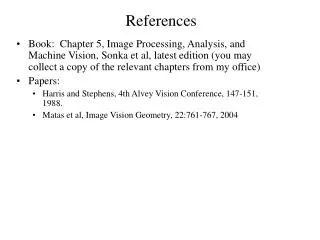
The Importance of References: A Guide to Citing Sources Effectively
Understanding the significance of providing references in academic work is crucial. References acknowledge previous work, prevent plagiarism, and lend authority to your arguments by indicating your sources. This guide explains how to properly cite references, including in-text citations and bibliography formatting, using systems like Harvard and numerical referencing. By following these guidelines, you ensure that readers can access sources for further information, support your claims, and demonstrate your familiarity with literature. Consistent referencing enhances the credibility of your work.


The Importance of References: A Guide to Citing Sources Effectively
E N D
Presentation Transcript
References Why & How?
Why provide references? • Acknowledge and refer to previous work • Avoid plagiarism • Indicate your sources and provide authority for your evidence. • justify and support your arguments • enable comparisons • express things better than you can • Use quotes properly and sparingly • demonstrate familiarity with the literature on a subject
Using references • References comprise two parts • The citation in the text • The list of references or bibliography at the end • The citation alerts the reader to the source you have consulted for this particular piece of evidence. • The list of references enables the reader to go and read the original source, should they so wish. • So; both are essential.
Bibliographic details • Author(s) • Year of publication • Title of article (in full) • For journals • volume, part, pages • For books • Edition • (Chapter and/or pages) • Location and Name of Publisher. • Keep these records in electronic format.
Citing References • By name (The Harvard System) • Smith (2000) showed that ... • It has be argued that … (Jones 1999) • With multiple authors list both authors if there are two or use et al after the first author’s name for more than two • The Number system • Smith (6) showed that … • It has been argued that7 … • Only use superscripts if they are not to be used for other purposes.
Listing References (Bibliography) • Citing by name • List in alphabetical order of first author’s name • Single authors before joint authors, date order (a, b, c etc for more than one in a year). • Citing by number • Either • Numbered in order of first appearance in text • Or • Numbered in alphabetical order
Advantages/Disadvantages • Harvard system • Authors name serves as a reminder • Easy to Add/removing citations • Can make text look cluttered & interrupt flow • Number system • Takes little space • less distracting for reader • Adding/removing citations involves renumbering. • Use whichever you feel comfortable with, but be consistent
For more details Go to the DISSC Website: http://dissc.tees.ac.uk/mainmenu.html