Essential Guide to Concrete Projects: Preparation and Placing Techniques
This guide covers essential steps for preparing and placing concrete effectively. Start by preparing forms and ensuring they are properly soaked to prevent moisture loss. Reinforcing steel should be cut to size and positioned before concrete arrives. During the placing process, use level layers and vibrate the concrete to eliminate voids for a dense finish. Avoid overworking the mix and ensure a well-compacted surface. Key tools include shovels, spades, rakes, and straight edges to assist in achieving the perfect pour and final finish.

Essential Guide to Concrete Projects: Preparation and Placing Techniques
E N D
Presentation Transcript
Form preparation • A. Oil the form faces that come in contact with the concrete. • B. Thoroughly soak the sub-base and forms with water before the concrete is placed. • C. The reinforcing steel should be cut to the correct size (length) and placed prior to the arrival of the ready-mix truck, or after mixing in portable mixer.
General preparation • A. Be sure the site is ready and waiting when the mix truck arrives, because you may be charged for any time delays. • B. Have adequate labor present when the ready-mix truck arrives. • C. Plan your job so the ready-mix truck can get as near to the site as possible.
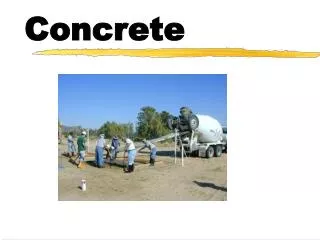
Placing concrete • A. Deposit the concrete in level layers, consolidating it just enough to make the concrete settle thoroughly and produce a dense mass. • B. Vibrate the concrete to make sure all the voids are filled and this will ensure a smooth, dense surface when the form is removed. • C. Concrete should be placed between the forms as nearly as practical to its final position. • D. Spade the concrete as it goes into the forms and next to the forms to eliminate voids or honeycombing at the sides. • E. Overworked concrete in the plastic form will allow too much water and fine materials to be brought to the surface. This will lead to scaling or dusting of the surface. • F. Use extra care in working materials into corners and angles of forms and around the reinforcing steel.
Placing concrete • G. Do not dump the concrete in separate piles and then level it by working the piles together. • H. Do not use a soupy mix and hope to float the concrete into its final position. Segregation occurs because the mortar tends to flow ahead of the coarser aggregate. • I. A good rule of thumb is, Agood concrete is placed, not poured.@ • J. After concrete is placed use a straight edge to level and compact the surface. • K Concrete should be placed 30 to 45 minutes from the time water has been added to the mix.
Tools need to place concrete • A. Shovel • B. Spade • C. Rake • D. Straight edge