Transient Drainage
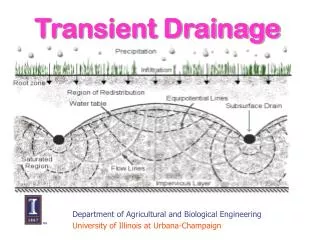
This study examines a controlled drainage system installed in soil with specific hydraulic properties. The objective is to determine the optimal timing for opening the drainage structure to achieve a mid-plane water table level three feet below the soil surface by 6 AM on April 28, coinciding with planting. The analysis utilizes the Bouwer-van Schilfgaarde Glover-Dumm Equation and assumes a parabolic water table shape. Initial conditions include a water table at the surface and no rainfall during the observation period. The resulting time for optimal drainage is calculated to be approximately 7 days and 11 hours.

Transient Drainage
E N D
Presentation Transcript
Transient Drainage Department of Agricultural and Biological Engineering University of Illinois at Urbana-Champaign
de Falling Water Table m0 m 2r h S d IMPERMEABLE LAYER
dA = p(m-dm)S/2-pmS/2 = -pdmS/2 m-dm m 2r h S d IMPERMEABLE LAYER
A controlled drainage system is installed in a soil having a drainable porosity of 0.066, a hydraulic conductivity of 0.12 ft/hr and an impervious layer 12 ft below the drains. The drains are installed 4 ft below the soil surface and spaced 120 ft apart. If the water table is initially held at the soil surface, determine the time when the controlled structure should be opened to allow the mid-plane water table to be 3 ft below the soil surface at 6 am on April 28 when the farmer begins planting. Assume that the water table shaped like a fourth degree parabola and that no rain falls over the period when the water table is falling.
= 178.74 hrs = 7 days 10.75 hrs
de Falling Water Table with Accretion R m0 m 2r h S d IMPERMEABLE LAYER
Falling with Accretion (DeZeeuw-Hellinga) No contribution from above tile
Falling with Accretion (Cooke)
N m q x 2r o h o S N m q h x h(x) L 2r o h o x L(t)
20d10d 4d 1d DRYING WT PROFILES WETTING WT PROFILES Transient Nature of Water Table Simulated water table from HYDRUS 2D 100 cm 20d20.02d20.03d20.07d20.12d20.14d 100 cm 2500 cm
Single Tile without Accretion (Cooke)
Single Tile with Accretion (Cooke)
Drainage Coeff.
Design Criteria
Sedimentation Options
Design Chart
Can be Saved