
SlideServe
Menu
Préférences
© SlideServe · v2026

Large-scale Structure Simulations

lefty avatar
18 diapositives · 371 Views · Oct 24, 2014

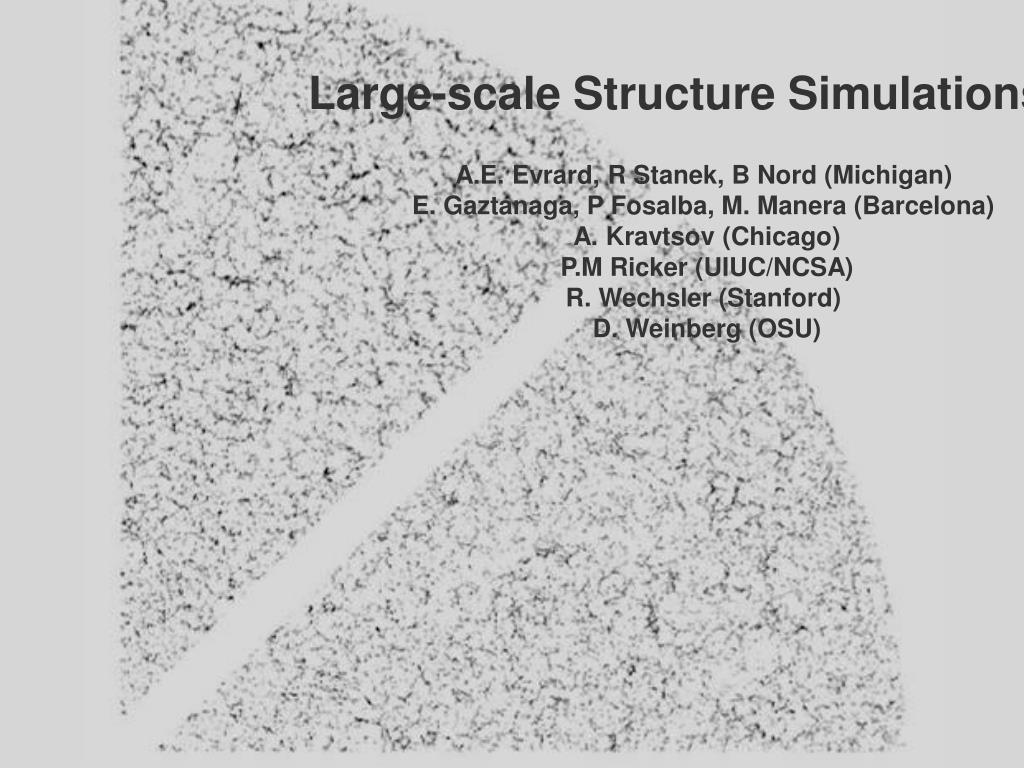
Large-scale Structure Simulations. A.E. Evrard, R Stanek, B Nord (Michigan) E. Gaztanaga, P Fosalba, M. Manera (Barcelona) A. Kravtsov (Chicago) P.M Ricker (UIUC/NCSA) R. Wechsler (Stanford) D. Weinberg (OSU). core science areas. non-linear evolution of the matter density
Large-scale Structure Simulations - slide 1
01 / 18Large-scale Structure Simulations
1 / 17

Télécharger la présentation

Large-scale Structure Simulations
Une image / un lien ci-dessous est fourni (tel quel) pour télécharger la présentation

Politique de téléchargement : le contenu du site vous est fourni TEL QUEL pour votre information et votre usage personnel ; il ne peut être vendu, concédé sous licence ni partagé sur d’autres sites sans l’accord de son auteur.Le contenu vous est fourni TEL QUEL, pour votre information et votre usage personnel uniquement. Téléchargez la présentation en cliquant sur ce lien. Lors du téléchargement, si vous ne parvenez pas à télécharger une présentation, l’éditeur a peut-être supprimé le fichier de son serveur.Pendant le téléchargement, si vous ne parvenez pas à obtenir une présentation, le fichier a peut-être été supprimé par l’éditeur.

F I N

Plus de contenu associé

Transcription de la présentation
  1. Large-scale Structure Simulations A.E. Evrard, R Stanek, B Nord (Michigan) E. Gaztanaga, P Fosalba, M. Manera (Barcelona) A. Kravtsov (Chicago) P.M Ricker (UIUC/NCSA) R. Wechsler (Stanford) D. Weinberg (OSU)

  2. core science areas • non-linear evolution of the matter density • P(k) for weak lensing, BAO • halo characterization for clusters, BAO, weak lensing • gas dynamic simulations of clusters • g(ySZ ,Ngal, …| Mhalo,z) : form of observable-mass relation • sensitivity to galaxy/AGN physics • mock sky surveys of galaxies and clusters • SZ + optical cluster finding : test self-calibration • multiple techniques to model galaxy formation and evolution • empirical: halo occupation, ADDGALS • first principle: SAM’s, direct gas dynamic • 100 sq deg now, several x 1000 sq deg by mid-2007

  3. mpi-based large-scale structure codes • GADGET: tree-PM N-body + Lagrangian hydro (SPH) • ART: tree N-body + Eulerian, adaptive-grid hydro • FLASH: PM N-body + Eulerian, adaptive-grid hydro • compute resources • Marenostrum @ BCN (104 cpus,106 hours + 100 Tb) • NCSA allocations of cycles and storage • local compute clusters (~100 cpu’s) and storage (~10 Tb) • each billion particle run generates ~10Tb of output • NASA AISR proposal to grid-enable this work (follow DM lead) methods and resources

  4. Springel et al 2005 Millennium Simulation (MS) L=500 Mpc/h Ωm=0.25, ΩL=0.75, h=0.73, s8=0.9 1010 particles mp=8.7e8 Msun/h halo/sub-halo catalogs semi-analytic galaxies test red-sequence cluster finding

  5. workflow view of galaxy formation star / SMBH formation

  6. Croton et al 2006 galaxy samples 2 galaxy types in a halo: central - accrete gas + form stars satellite - no gas accretion or star formation red sequence in halos w/ Ngal ≥ 4: width of r–z color grows with redshift factor ~2 wider than observed

  7. halo occupation of red-sequence galaxies z = 0.41 regular behavior slope slightly steeper than 1 no funny `dark’ clusters

  8. apply simple cluster finder to volume projections • Aim: lower-bound on blending due to supercluster projections • –use periodic BC’s to re-center volume around each galaxy • - apply linear color gradient to fore/background simple cluster finder based on mean sky density (parallels 3D algorithm used to define halos) for brightest galaxy – re-center volume on galaxy – apply line-of-sight color gradient for z-evolution – grow disc until mean RS number density threshold is reached – assign group members if Ngal≥Nmin (=4) repeat for next available (non-assigned) galaxy r–z color redshift

  9. cluster classification based on halo matching fbest = Ngal(halo) / Ngal(cluster) for the halo contributing the largest number of galaxies 2 classes: clean: fbest ≥ 0.5 (plurality is majority) blended: fbest < 0.5 (plurality is minority)

  10. cluster richness-mass relation red sequence cluster finding recovers well the intrinsic halo occupation clean: fbest ≥ 0.5 blended: fbest < 0.5 halo cluster

  11. conditional likelihood of halo mass at fixed richness halos clusters

  12. conditional likelihood of halo mass at fixed richness halos clean clusters blended clusters Next step: test whether SZ signatures will remove blends consider bi-modal likelihood p(M|Ngal) ?

  13. F. Pearce, L. Gazzola (Nottingham) + Virgo Consortium collaborators R. Stanek, B. Nord (Umich) MS w/ gas: halo space density M200 mass function : run 0 open: DM only filled: DM + gas 5x10⁸ particles mdm=1.4x10¹⁰ Msun/h mgas=2.9x10⁹ Msun/h 3 simulations:0. gravity only 1. cooling + heating I 2. cooling + heating II Evrard et al (2002) `prediction’

  14. MS w/ gas: scaling relations gas mass fraction thermal SZ gravity only cool+heat 1 gas temperature DM velocity dispersion

  15. MS w/ gas: covariance of observables high Lx systems are likely to be gas rich correl. coeff. r = 0.5 deviation in gas mass fraction deviation in X-ray luminosity

  16. MS galaxies match b+K band LF’s