Understanding Personality: Theoretical Approaches and Key Traits
This chapter from Samuel R. Mathews, Ph.D., explores various theoretical approaches to understanding personality. It investigates psychoanalytic, humanistic, and social cognitive frameworks, emphasizing the significance of past experiences, individual interpretation, and environmental influences. Central to this discussion is the distinction between personality states and traits, including the "Big Five" traits: openness, conscientiousness, extraversion, agreeableness, and neuroticism. The chapter also addresses cultural factors and suggests a bio-psycho-social perspective that recognizes the relative stability of personality while allowing for growth and change.

Understanding Personality: Theoretical Approaches and Key Traits
E N D
Presentation Transcript
Personality: Chapter 11 Samuel R. Mathews, Ph.D. The Department of Psychology The University of West Florida
Personality • “…the thread of consistency that runs through our lives (Cervone & Shoda, 1999)” cited in Zimbardo et al. (2006, pg. 444).
Theoretical Approaches to Understanding Personality • Psychoanalytic • Unconscious forces and drives • Past experiences, particularly early attachments • Sigmund Freud
Theoretical Approaches to Understanding Personality • Humanistic • Individual interpretations of experiences • Relationships with significant others • Carl Rogers
Theoretical Approaches to Understanding Personality • Social Cognitive • Learning-based, particularly from significant role models through observational learning • Individual interpretations of experiences, particularly experiences involving social interactions • Perceptions of one’s own ability to affect change (perceived self efficacy) • Bandura
Personality: State or Trait • State: relatively transient attribute of the individual • Trait: relatively stable and permanent attribute of the individual
Personality: State or Trait • Temperament: early manifestation of personality • Linked to both genetic predisposition and environmental response to that disposition • Family of origin’s reactions can moderate impact even during early infancy • Some elements of state and trait theory in personality
“Big Five” Traits • Openness to experience: Breadth, Complexity, and depth of an individual’s life (closed minded) • Conscientiousness : Impulse control, goal directed behavior (carelessness) • Extraversion: activity and energy level traits, sociability and emotional expressiveness. (introverted)
“Big Five” Traits • Agreeableness: altruism, trust, modesty, prosocial attitudes. (negativity) • Neuroticism : emotional stability, anxiety, sadness, and irritability (unstable, anxious) • Assessment is frequently conducted with the Minnesota Multiphasic Personality Inventory (MMPI—2) with 10 Clinical Scales
Alternative to Trait Theories • Problems—Trait theories portray personality as a static system rather than a system that reflects a true bio-psycho-social system capable of change
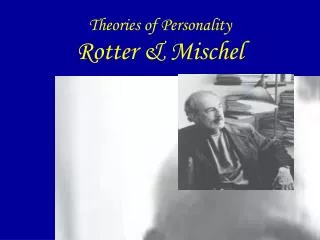
Alternatives to Trait Theories • Social Cognitive Theory • Allows for flexibility within a wide range based on environmental forces and one’s temperament • Mischel’s Person-Situation Argument: • Personality Traits tend to surface and are consistent when situational cues are inconsistent or weak
Cultural Issues and Personality • Individualism and Collectivism • One’s status within a culture (economic, sex, age) • Locus of control (sense that one is in control of outcomes) • Relationship between thoughts and feelings
Personality • Personality is relatively stable but not unchangeable • Bio-psycho-social perspective provides the most far-reaching explanation