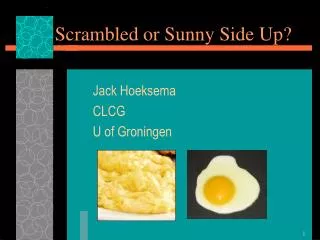
Scrambled or Sunny Side Up? Exploring the Scrambling of Definite Noun Phrases
This study analyzes the phenomenon of scrambling in Dutch, focusing on the interaction between anaphoric and non-anaphoric definite noun phrases. Using Optimality Theory (OT), it evaluates constraints that lead to either scrambling or non-scrambling outcomes, revealing its probabilistic nature based on context. Data from informal collections and online sources demonstrate a trend away from scrambling with non-anaphoric objects. This research highlights the nuances of sentence structure and the implications for understanding communication dynamics in Dutch.

Scrambled or Sunny Side Up? Exploring the Scrambling of Definite Noun Phrases
E N D
Presentation Transcript
Scrambled or Sunny Side Up? Jack Hoeksema CLCG U of Groningen
Scrambling of definites • Scrambling Je hoeft je bord niet leeg t te eten You have your plate not empty to eat “You don’t have to finish your plate’ • Or not: Je hoeft niet je bord leeg te eten
OT conditions (De Hoop 2003) • NEW: Anaphoric elements scramble (Anaphoric: prior mention: old before new) • STAY: No scrambling • SC1 (= Surface Correspondence 1): Definites Scramble
Anttila’s Theory of Variation • An output candidate is predicted by the grammar iff it wins in some tableau (given a partial ranking of constraints) • If a candidate wins in n tableaux and t is the total number of tableaux, then the candidate’s probability of occurrence is n/t
Anaphoric Definites • 3 constraints relevant, so 6 possible orderings • when STAY dominates the rest, there is no scrambling, otherwise scrambling is optimal • in 2 out of 6 orderings, STAY is dominant • So probability of scrambling is 2/3
Nonanaphoric definites • NEW is irrelevant • so only the interaction of STAY and SC1 matters • when STAY > SC1, no scrambling • when SC1 > STAY, scrambling • hence probability of scrambling for nonanaphoric definites is 1/2
Bidirectional perspective: Case 1, Scrambling • Hearer perspective: both interpretations are optimal in case of Scrambling
Bidirectional perspective:Case 2, Nonscrambling • Hearer perspective: in case of nonscrambling, nonanaphoric reading is optimal. Note that the ordering of the constraints is irrelevant
So • De Hoop’s production OT predicts for [+anaphoric] definite noun phrases 67% scrambling, 33% nonscrambling • Bidirectional OT (using De Hoop’s constraints) would predict 100% scrambling, since nonscrambling would lead to [–anaphoric] readings
Some specific combinations • Ik kan die vent niet uitstaan I can that guy not stand ‘I cannot stand that guy’ • *Ik kan niet die vent uitstaan Note: die vent is an epithet, so +def, +anaphoric
Internet data • die vent niet uitstaan: 33 occurrences (Google) • niet die vent uitstaan: 0 occurrences
other epithets, with de • Ik kan de man niet uitstaan I can the man not stand ‘I can’t stand the guy’ • *Ik kan niet de man uitstaan
or het • Ik kan het mens niet luchten I can the woman not stand ‘I can’t stand the woman’ • *Ik kan niet het mens luchten
or with other adverbs • Ik heb het mens nog gewaarschuwd I have the woman yet warned ‘I did warn the woman’ • *Ik heb nog het mens gewaarschuwd
De/het N niet aankunnen ‘the N not can handle’ • Hij kon de druk niet aan. He could the pressure not on ‘He couldn’t handle the pressure’ Corpus data • Def. Object: 37 cases of Scrambling • 0 cases of Nonscrambling order
[-anaphoric] • You have the right to remain silent • Het recht ‘the right’ • De tijd ‘the time’ • De moed ‘the courage’ • De energie ‘the energy’
Rise of nonscrambling +def, –anaph direct objects of have/give/get (raw numbers)
Rise of nonscrambling order among +def, –anaph direct objects of have/give (in %)
Zo veel N “so much N” • Ik heb niet zo veel geld I have not so much money ‘I don’t have so much money’ • Ik heb zo veel geld niet
Conclusions • Scrambling of [- ANAPHORIC] definite objects is slowly on its way out • Scrambling is highly sensitive to the difference between [+ANAPHORIC] and [-ANAPHORIC] definites • Stochastic OT is probably more suitable for describing scrambling than Anttila’s theory of variation
References • Helen de Hoop, 2003, ‘Scrambling in Dutch: Optionality and Optimality’, in: Simin Karimi, ed., Word Order and Scrambling, Blackwell. • Arto Anttila & Young-mee Cho, 1998, ‘Variation and Change in Optimality Theory.’ Lingua 104:31-56.