Understanding Enzymes: Role, Activation Energy, and Factors Affecting Activity
This overview explores the function of enzymes in metabolic pathways, highlighting their role as catalysts that speed up chemical reactions, such as those in photosynthesis. Key concepts include activation energy—the energy needed for reactions to initiate—and the structural dynamics between enzymes and substrates. It also covers models of enzyme activity, specifically the induced-fit and lock-and-key models, along with factors influencing enzymatic efficiency like substrate concentration, temperature, and pH. Additionally, enzyme activation, inhibition, and the importance of cofactors are discussed.


Understanding Enzymes: Role, Activation Energy, and Factors Affecting Activity
E N D
Presentation Transcript
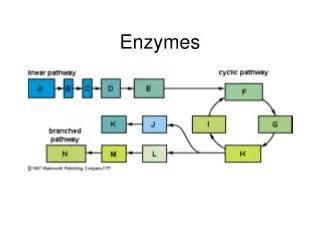
Target #13- I can describe an enzyme • Reactions, like those in photosynthesis are a part of a metabolic pathway, a series of linked reactions • Enzymes are a type of protein that functions to speed up chemical reactions • Ex: Rubisco from the Calvin Cycle • Are also known as a catalyst • Contributes to the rate of the reaction, but is not a reactant or product
Target #14- I can explain Activation energy • Some energy must be absorbed by the reactants in any chemical reaction • Activation Energy: the amount of energy that needs to be absorbed for a chemical reaction to start
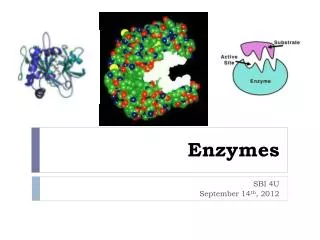
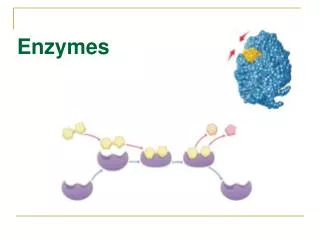
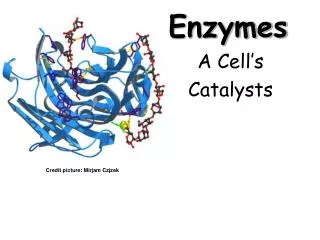
Active Site: the surface depressions where the enzyme and substrate connects • Substrate: the molecule on which the enzyme acts • Has to fit into the active site of the enzyme • Temporarily bind to enzymes at specific places called activate sites • Like a lock-and-key Target #15- I can describe the Pieces associated with enzyme activity
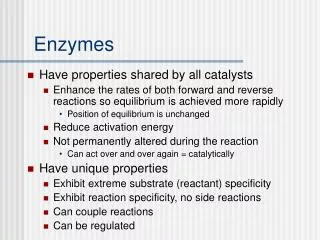
Target #16- I can differentiate between the two models describing enzyme activity • Induced-Fit Model • Binding to a substrate may cause the enzyme to change shape slightly in order to fit • Each enzyme’s active site is shaped so that only a certain substrate molecule will fit • Lock-and-Key Model • Substrates exactly fit the active site of their corresponding enzyme • Enzymes bring substrate molecules close together • Enzymes decrease the activation energy needed and a chemical reaction can occur
Target #17- I can explain the factors that affect enzyme activity • The rate of enzymatic activity is dependent upon several factors • Substrate concentration • Generally, the higher the amount of substrate, the higher the rate of activity • Has a maximum rate of productivity • Temperature & pH • As the temperature rises, so does the rate of enzymatic activity • Has a maximum rate of productivity • Rate of enzyme activity decreases eventually due to the enzyme becoming denatured • Causes the enzyme to change shape, and no longer functions • Perferred pH varies according to the enzyme • Most require a neutral pH
Enzyme activation • Not all enzymes are needed at all times • Can be activated by adding or removing phosphates, or by adding or removing parts of the protein • Enzyme Inhibition • Occurs when the substrate is unable to bind to the active site of an enzyme • Activity is regulated by feedback inhibition • As the products of the reactions are used up, enzyme activity increases and inhibition decreases • Enzyme Cofactors • Some enzymes need an inorganic ion, like copper metal, called a cofactor • Some enzymes need an organic molecule, like vitamins, called a coenzyme Target #17- cont.