Comprehensive Guide to the Modern Periodic Table: Elements and Organization Principles
100 likes | 202 Vues
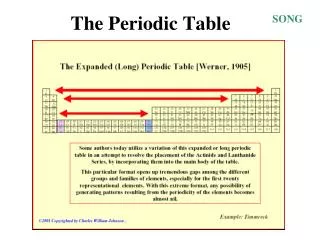
Learn the fundamentals of the modern periodic table, including organization by increasing atomic mass and atomic number, columns (groups) and rows (periods), main group and transition elements, regions of metals, nonmetals, and metalloids. Explore the named families, including alkali metals, alkaline earth metals, chalcogens, halogens, and noble gases, as well as the blocks of elements and sub-periods like lanthanides and actinides. This guide provides essential insights into the structure and classification of elements within the periodic table for better understanding.


Comprehensive Guide to the Modern Periodic Table: Elements and Organization Principles
E N D
Presentation Transcript
The Periodic Table Important Basics
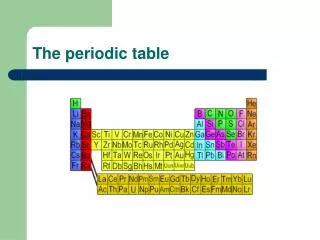
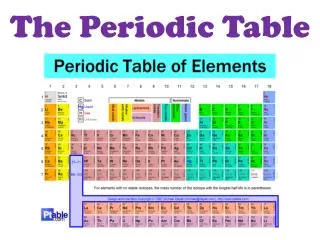
The Modern Periodic Table • Organization • Increasing At. Mass • Increasing Z
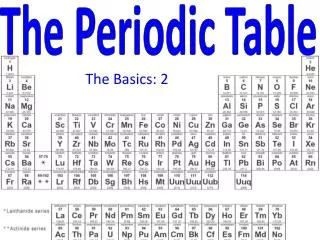
The Modern Periodic Table • Organization • Increasing At. Mass • Increasing Z Columns (Groups)
The Modern Periodic Table • Organization • Increasing At. Mass • Increasing Z Columns (Groups) Rows (Periods)
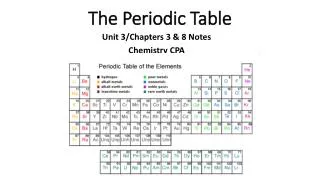
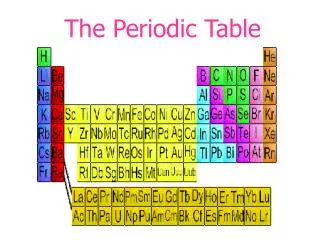
Regions • Main Group (Representative) Elements Transition Elements
Regions • Stair-Step Line Metals to the West Nonmetals to the East Metalloids on the Line
Named Families • Alkali Metals (Group I or 1) Alkaline Earth Metals (Group II or 2) Chalcogens (Group VI or 16)
Named Families • Alkali Metals (Group I or 1) Alkaline Earth Metals (Group II or 2) Chalcogens (Group VI or 16) Halogens (Group VII or 17) Noble Gases (Group 0 or 18)
Named Sub-Periods Lanthanides Actinides
s b l o c k p-block d-block f-block Blocks (Related to QM) • s-block elements p-block elements d-block elements f-block elements