Understanding the Articles of Confederation: America's First Government Framework
60 likes | 182 Vues
The Articles of Confederation, established by the Second Continental Congress in 1777 and ratified in 1781, represented America's initial attempt at a unified government during the Revolutionary War. Crafted to counterbalance the feared power of a monarch, it created a weak central government while empowering states. Despite successfully coordinating the American Revolution and negotiating peace with Britain, the Articles had notable weaknesses, including the inability to collect taxes, regulate trade, or raise an army without state consent. This system was replaced by the U.S. Constitution in 1789.


Understanding the Articles of Confederation: America's First Government Framework
E N D
Presentation Transcript
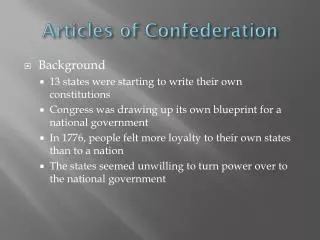
Who was ruling the colonies during the Revolutionary War? • America’s first attempt at a government… • The Articles of Confederation • Colonists feared the power of an absolute monarch, so they designed a government with a weak federal system and powerful state governments
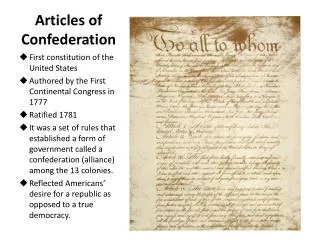
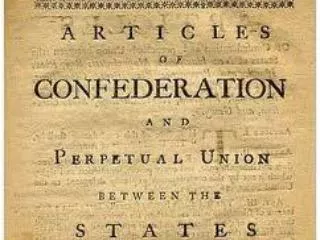
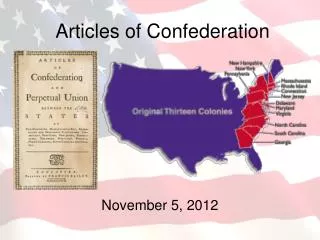
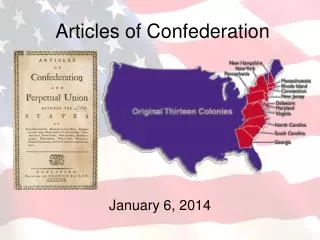
Articles of Confederation • Passed by the Second Continental Congress in 1777 • Ratified in 1781, ruled America until the Constitution was created in 1789
What’s the difference between a confederationand what we have now? • Confederation • Alliance of independent states that maintain the majority of power and sovereignty at the expense of a weak central government • Federal System • Partially self-governing states united by a central federal government
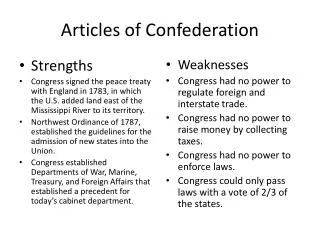
Strengths of the gov’t under the AoC! • Coordinated the colonists’ fight against the British in the American Revolution • Negotiated peace treaty that ended American Revolution (Treaty of Paris 1783) • Passed Northwest Ordinance to organize settlement of the Midwest • Created method to amend (change/add to) the Articles of Confederation
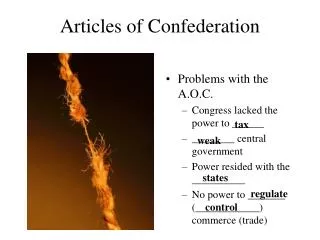
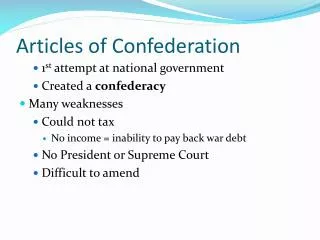
Weaknesses of the gov’t under the AoC? • Could NOT collect taxes without approval of states • Could NOT regulate trade • Could NOT raise an army without approval of states • Amendments required unanimous approval of all the states • States retained their sovereignty, freedom and independence • No separate executive (President) • Each state only had one vote in Congress • Congress can only operate on states, not on citizen • Could not enforce treaties