Translation
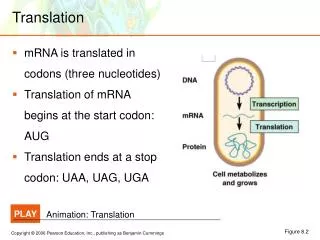
This guide explores the process of mRNA translation, detailing how codons (three-nucleotide sequences) instruct ribosomes to synthesize proteins. Each codon is matched by an anticodon on tRNA, which brings the corresponding amino acids. Key codons are decoded into their respective amino acids, exemplified by AUG, UCU, and others. This foundational knowledge is essential for understanding gene expression and protein synthesis. Included are interactive resources to enhance learning.

Translation
E N D
Presentation Transcript
Translation Objective 4,6
Decoding mRNA • The mRNA strand is divided into smaller parts called codons (words) • A codon is three nucleotides (letters) mRNA= GCG-GAA-UAU • The rRNA (ribosomal RNA) translate the codons into amino acids • Write the Amino Acids for the above three codons here: __________ - ___________ - ___________ using the chart on the next slide…
Practice • Which amino acids match the following codons: • AUG = ______________ • UCU = ______________ • UCG = ______________ • CCA = ______________ • GCA = ______________ • GGG = ______________ • UAA = ______________
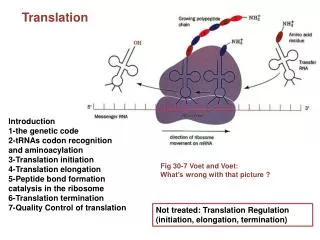
Translation • Transfer RNA (tRNA) brings the amino acids to the ribosome • tRNA knows which amino acids to bring because they have anticodons which are complimentary to codons: mRNA= GCG-GAA-UAU codons tRNA= ____-____-____ Answer: CGC-CUU-AUA anticodons • The amino acids brought by the tRNA are connected together to make proteins (genes)
Review • What type of nucleic acid has codons? • What type of nucleic acid has anti-codons? • What type of nucleic acid has genes?
Translation • Activity: • http://www.pbs.org/wgbh/aso/tryit/dna/# • Video: • http://www.dnai.org/a/index.html