Similarity of Triangles: Determining Similarity and Writing Statements
190 likes | 356 Vues
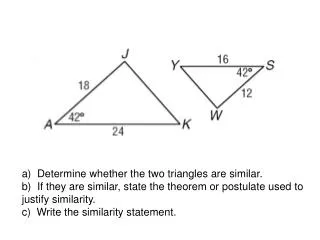
In this exercise, we explore the similarity of two triangles through various methods. First, we determine whether the triangles are similar based on side lengths and angle measures. If they are similar, we identify the theorem or postulate that justifies the similarity, such as the Angle-Angle (AA) or Side-Angle-Side (SAS) theorems. Additionally, we will write the similarity statement reflecting the relationship between the triangles. Specific cases for triangles ∆JAK and ∆WSY, as well as ∆LMN and ∆PQN, will be analyzed and solved for unknown variables.


Similarity of Triangles: Determining Similarity and Writing Statements
E N D
Presentation Transcript
a) Determine whether the two triangles are similar. b) If they are similar, state the theorem or postulate used to justify similarity. c) Write the similarity statement.
Yes, SAS ∆JAK ~ ∆WSY
a) Determine whether the two triangles are similar. b) If they are similar, state the theorem or postulate used to justify similarity. c) Write the similarity statement.
No, sides are not proportional
a) Determine whether the two triangles are similar. • b) If they are similar, state the theorem or postulate used to justify similarity. • Write the similarity statement. • Solve for x
Yes, AA ∆LMN ~ ∆PQN X = 9
a) Determine whether the two triangles are similar. • b) If they are similar, state the theorem or postulate used to justify similarity. • Write the similarity statement.
Yes, AA ∆KSM ~ ∆TRQ
X = 9 Y =16
X = 108 Y = 180