Understanding Nouns: Types, Examples, and Their Sounds
140 likes | 243 Vues
Explore the fascinating world of nouns, the building blocks of language. Learn about different types of nouns, including proper and common nouns, and discover how they name people, places, things, and ideas. Delve into the distinction between concrete nouns, like "rock," and abstract nouns, such as "freedom." Uncover the roles of singular and plural forms, along with the audible traits of nouns that reflect their meanings. Engage with classic examples, from Chaucer to Shakespeare, to see the enduring impact of nouns in literature.


Understanding Nouns: Types, Examples, and Their Sounds
E N D
Presentation Transcript
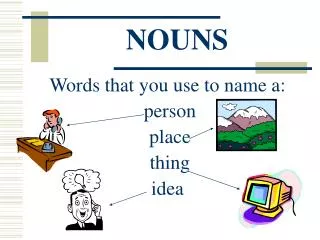
Nouns • A person, place, or thing
The word noun comes from the latin word nomen, name, and that is what a noun does; it names.
A noun can also be the name of a process, such as the beginning.
Proper nouns, like Mozart, are capitalized while common nouns, like epidermis, are not.
Concrete Nouns • rock • are names of objects
Abstract Nouns • freedom • are names of ideas
Nouns are singular if they describe individual things and plural if they describe multiple things (Boat/Boats)..
Noun sounds: words often have sounds that echo what they name; bang, slime, crash, trickle, drop, fuzz, and crunch- some of which can also be used as verbs- have an audible relationship to their objects.
A classic noun: • visage
The common noun, visage, which indicates the face or the expression on the face, is a classic noun that’s been in literary use for centuries.
“This olde man gan loke on his visage.”- Chaucer, 1385 • “Give me a case to put my visage in”-Shakespeare, Romeo and Juliet • “Mr. Patton’s granite visage seemed to lean toward me like a monument about to fall.”- Robert Penn Warren, All The King’s Men