Explore Global Music: Instruments and Cultural Heritage
50 likes | 175 Vues
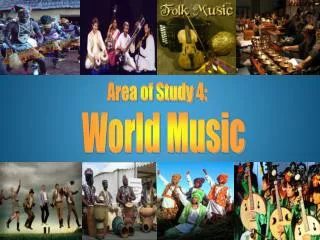
This International Band course invites students to present their chosen instruments, sharing musical selections that reflect their individual styles. While one student performs, the next prepares, fostering a collaborative and dynamic environment. The curriculum spans diverse music regions including Northern and Southern India, the Middle East, China, Japan, Indonesia, Sub-Saharan Africa, Europe, Latin America, the Caribbean, and Native American traditions. Students will engage in evaluations to enhance course feedback, emphasizing the integration of cultural identity and music.


Explore Global Music: Instruments and Cultural Heritage
E N D
Presentation Transcript
MUSI 207World Music Course Summary International Band
International Band Each student will briefly present his/her instrument and play it with a musical selection of choice. While one student is presenting, the next “on deck” will be getting his/her music ready to go. After all have presented, we will play together.
Course Summary India (Northern Hindu, Southern Muslim) Middle East (monophony, ornamentation, improvisation) China (Politics: Confucius vs. Mao ZeDong) Japan (cultural and gender issues, Kabuki, Noh, etc.) Indonesia (Gamelan and influence of tourism) Sub-Saharan Africa (interlocking, call and response, com.) Europe (folk vs. urban, national styles) Latin America (socio-cultural heritage, social identity) Caribbean (shared colonial past, diversity and integration) Native American (supernatural, intertribal styles) Ethnic North America (commercialization vs. authenticity)
Evaluations • There are two evaluations to be filled out. You will receive bonus points for filling out evaluations. • Personal Evaluation – goes in the envelope (will not be viewed until AFTER grades have been posted) • Univ. Evaluation – goes in the official folder. Do not sign your name on either of these. Thanks for your feedback; I really do use it for future courses!
Pause for a moment today and listen to the music of your soul.