Download

1 / 22
220 likes | 326 Vues
The NF-κB signaling pathway is crucial for various cellular responses, particularly in immune functions and inflammation. This pathway involves dimerization of transcription factors such as p50 and p65, regulated by IκB proteins. In Hodgkin's lymphoma, the Reed-Sternberg cells exhibit continuous NF-κB activity, allowing them to evade apoptosis and promote proliferation. Strategies for therapeutic intervention include the use of IkB super-repressors and bortezomib, a proteasome inhibitor. This overview discusses the structure, function, and post-translational modifications associated with NF-κB components.

E N D
Introduction • NF-kB - transcription factors • P105 • P50 • IkB • Five types • P105 – inactive • P50 – active
Orientation of p105 • The N-terminal - p50. • The C-terminal - IkBγ,
Post-translational Processing Pathway Moorthy AK. EMBO. 2006; 25(9): 1945-1956.
Structure of transcription factor • Dimer • RHR-c - dimerization • Sequence specific interactions
IkBα • three main regions • Function
IkB Cell. 1998; 95: 749-58.
NLS of p65 interacting with IkB Cell. 1998; 95: 749-58.
p50/p65 heterodimer • β-sheet sandwich • hydrophobic core • p50/p65 heterodimer greater stability than p50 homodimer • High DNA affinity
P50/p65 heterodimer with IkB Cell. 1998; 95: 749-58.
P50/p65 heterodimer bound to DNA Nature. 1998; 391: 410-3.
p50/p65 DNA binding sites • Structure. 2002; 10(3): 383-391.
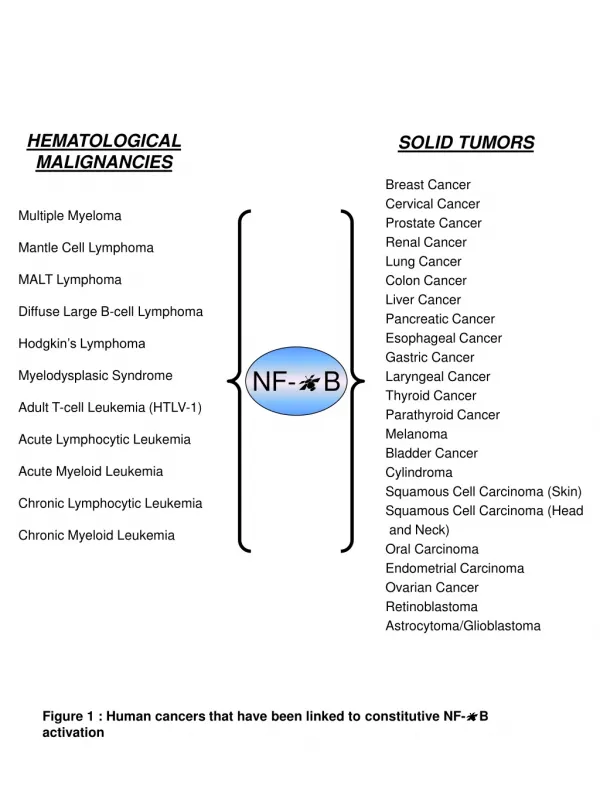
Hodgkins Lymphoma • malignant tumors in the lymph system • Hodgkin and Reed-Sternberg (HRS) cells • Cells exhibit constitutive NF-kB activity • Cells resist apoptosis • Somatic hypermutation of Ig region • low affinity - die by Fas-mediated apoptosis • high affinity - stimulated to proliferate
Treatment • IkB super repressor • bortezomib - Proteasome repressor • Novel solution – c-FLIP inhibitor