Download
1 / 9
110 likes | 233 Vues
This study explores the reduction of unintentional background electron density in AlSb/InAs/AlSb quantum wells, crucial for advancing high-frequency Heterojunction Field Effect Transistors (HFETs). The research, supported by DARPA, utilizes modulation doping with beryllium (Be) to achieve effective control over channel charge, demonstrating a linear relationship between Be doping and electron density. Findings reveal insights into scattering mechanisms affecting electron mobility and highlight the significant impact of channel charge on device performance. Future work aims to quantify these scattering mechanisms for improved HFET applications.

E N D
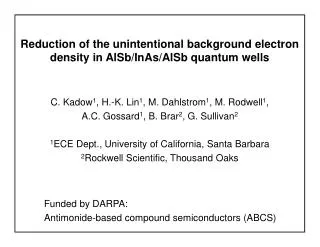
Reduction of the unintentional background electron density in AlSb/InAs/AlSb quantum wells C. Kadow1, H.-K. Lin1, M. Dahlstrom1, M. Rodwell1, A.C. Gossard1, B. Brar2, G. Sullivan2 1ECE Dept., University of California, Santa Barbara 2Rockwell Scientific, Thousand Oaks Funded by DARPA: Antimonide-based compound semiconductors (ABCS)
EF AlSb/InAs/AlSb quantum wells • High room-temperature mobility of 30,000 cm2/Vs. • High conduction band offset of 1.3 eV. Good channel for high-frequency HFETs. BUT: Intrinsic electron density is 1x1012 cm-2 mainly due to the surface pinning position. Control of the channel charge is essential for the HFET threshold voltage and other device parameters. Nguyen, C. et. al. APL 60, 1854 (1992)
75 A GaSb AlSb 200 A Be delta-doping sheet [Be] = 0 to 1.5 x 1012 cm-2 130 A InAs 300 A AlSb AlSb-based metamorphic buffer GaAs substrate Experiment: Sample structures EF -
Variations due to cool-down cycle and sample-to-sample non-uniformity
Control of channel charge • Linear relationship between Be doping and channel charge. • Slopes are different at T = 10 K and T = 300 K, probably due to different sources of charge (surface and interfaces). • Carrier freeze-out does not fit linear relationship.
Scattering mechanisms • Effects of Be modulation doping: • Increased ionized impurity scattering. • Reduce Fermi wavevector kF • Phonon scattering (room temperature). • Interface roughness scattering (low temperature).
Conclusions and summary • Demonstrated Be-doping as an effective tool to reduce the unintentional electron density in InAs quantum wells. • Channel charge varies linearly with Be doping. • Hall measurements show the dependence of the electron mobility on Be doping, electron density and temperature. • Future work: • Quantify scattering mechanisms. • Application to HFETs.