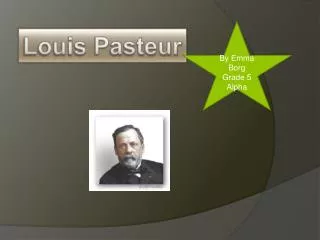
Discovering Louis Pasteur: The Pioneer of Germ Theory and Pasteurization
Louis Pasteur, born in Dole, France in 1822, was a groundbreaking bacteriologist whose work transformed the understanding of diseases. Defying the belief that germs appeared out of nowhere, Pasteur proved that bacteria come from the environment, supporting the germ theory of disease. His studies led to the development of vaccines for diseases like rabies and techniques such as pasteurization, which continues to ensure the safety of our food and drink today. Pasteur’s legacy as a scientific giant remains influential and relevant.

Discovering Louis Pasteur: The Pioneer of Germ Theory and Pasteurization
E N D
Presentation Transcript
By Emma Borg Grade 5 Alpha Louis Pasteur
Bacteriologist Louis Pasteur was born in Dole in the Jura region of France in 1822 and died in 1895. Louis Pasteur was one of the great scientific minds of the 19th century. Although his father was a tanner or leather maker and had very little education, Louis showed scientific aptitude at very young age and received his doctorate at age 24
In Pasteur ‘s days , many scientists still believed that certain organisms sprung to existence out of nowhere . They believed that mould just sort of magically appeared when bread was left out .
Pasteur then undertook experiments to find where these bacteria came from and was able to prove that they were introduced from the environment.
Pasteur's various investigations convinced him of the rightness of the germ theory of disease, which holds that germs attack the body from outside. Many felt that such tiny organisms as germs could not possibly kill larger ones such as humans. Pasteur now extended this theory to explain the causes of many diseases - including anthrax, cholera, TB and smallpox - and their prevention by vaccination.
Pasteurization • Louis Pasteur was able to demonstrate that organisms such as bacteria were responsible for the mould ,the souring wine and beer (he later extended his studies to prove that milk was the same)made the food get rotten. The bacteria could be removed by boiling and then cooling the liquid. This process is now called pasteurization.
In 1885 Pasteur developed the rabies vaccine . The safety technique called pasteurization is still in use today. The milk we drink is pasteurized - brought to a very high temperature to kill bacteria before it is sold in the shops.