
SlideServe
Menu
Préférences
© SlideServe · v2026

Lab 2

loyal avatar
10 diapositives · 150 Views · Feb 08, 2013

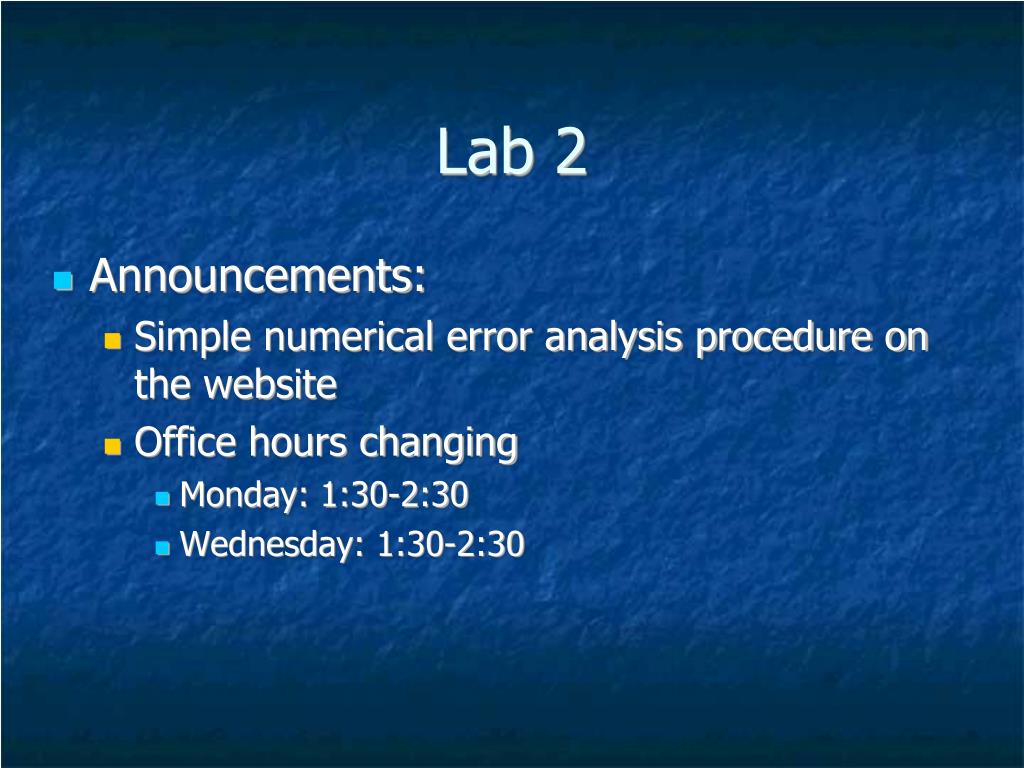
Lab 2. Announcements: Simple numerical error analysis procedure on the website Office hours changing Monday: 1:30-2:30 Wednesday: 1:30-2:30. Average (without zeros):71 Average (with zeros):59. Lab 1 Grade Distribution. Telescopes. We use telescopes to magnify distant objects
Lab 2 - slide 1
01 / 10Lab 2
1 / 17

Télécharger la présentation

Lab 2
Une image / un lien ci-dessous est fourni (tel quel) pour télécharger la présentation

Politique de téléchargement : le contenu du site vous est fourni TEL QUEL pour votre information et votre usage personnel ; il ne peut être vendu, concédé sous licence ni partagé sur d’autres sites sans l’accord de son auteur.Le contenu vous est fourni TEL QUEL, pour votre information et votre usage personnel uniquement. Téléchargez la présentation en cliquant sur ce lien. Lors du téléchargement, si vous ne parvenez pas à télécharger une présentation, l’éditeur a peut-être supprimé le fichier de son serveur.Pendant le téléchargement, si vous ne parvenez pas à obtenir une présentation, le fichier a peut-être été supprimé par l’éditeur.

F I N

Plus de contenu associé

Transcription de la présentation
  1. Lab 2 • Announcements: • Simple numerical error analysis procedure on the website • Office hours changing • Monday: 1:30-2:30 • Wednesday: 1:30-2:30

  2. Average (without zeros):71 • Average (with zeros):59 Lab 1 Grade Distribution

  3. Telescopes We use telescopes to magnify distant objects There are two major types of telescopes Refractors – use lenses Reflectors – use mirrors Many modern telescopes are a hybrid of the two Our telescopes are primarily reflectors, but have a corrector plate (big lens) on the front

  4. Magnification • The magnification is determined by the focal lengths of the telescope and eyepiece. (M=ftelescope/feyepiece)‏ • Focal length is the distance between the lens/mirror and where an object coming from infinity is focused • This is why many telescopes are long • Reflectors advantageous here – can fit a longer focal length inside a smaller region • Can you have too much magnification?

  5. Too Much Magnification Its tempting to zoom in as much as possible, but everything has limits More magnification makes image dimmer Light spread over a larger area You not only magnify your target, but everything in between as well (atmosphere)‏

  6. Brighter Images Most of what we look at through telescopes are far away and dim We want to make our images bright! How do we get brighter images  collect more light  make telescope wider Refractors at a disadvantage – can only be so wide Some times this is not enough Many images are long exposures Hubble Ultra Deep Field (11 days-worth of light collecting!!!)‏

  7. Celestial Coordinate Systems Right Ascension and Declination (RA/DEC)‏ Units? Why is it advantageous over other systems like latitude and longitude?

  8. And now tonight’s lab • We’ll be measuring field of view of our telescope (angular size seen through the telescope)‏ • Primary Method – timing of stars crossing the field of view • Can do this because the Earth rotates at a constant speed (15 degrees per hour)‏ • Time with a velocity gives a distance • In case of clouds • Can put the telescope into a rough alignment-->turns on the tracking motor • Look at a stationary object, moves like a star in the sky-->mimics the original process

  9. Procedural Notes Measure FOV crossing time at least 3 times and take an average. Don't forget to find theoretical field of view and compare it to your measured field of view. You'll need a couple of specs for the telescope and eyepiece – see the handout Mind your units! q(degrees)=15(degrees/hour) x t(hours)‏ q(arcminutes)=15(arcminutes/minute) x t(minutes)‏ q(arcseconds)=15(arcseconds/second) x t(seconds)‏