
Global Atmospheric Circulation Patterns
E N D
Presentation Transcript
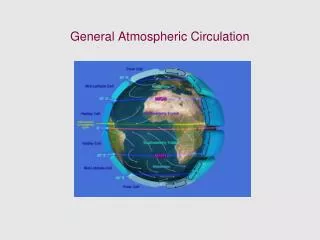
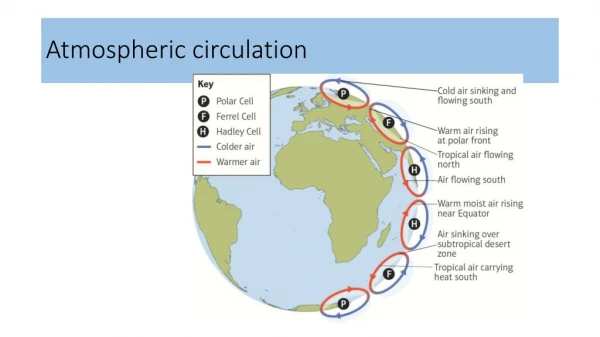
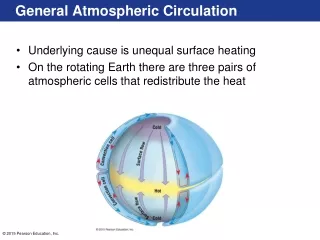
Features of the model • At boundaries, air is moving vertically • Surface winds are weak and erratic • Equatorial region • Lots of rain as humid air rises and loses moisture (rain forests) • Doldrums • Intertropical convergence zone (ITCZ) – winds converge • 30oN and S region • Sinking air is arid and evaporation >> precipitation (deserts and high salinity) • Horse latitudes
Features of the model • Air moves horizontally within the cells from areas of high pressure to areas of low pressure • Tropical areas – Hadley cells • Surface winds are strong and dependable • Trade winds or easterlies centered at ~15oN (northeast trade winds) and ~ 15oS (southeast trade winds) • Surface wind moves from horse latitudes to doldrums so come out of northeast in N hemisphere • Mid-latitude areas – Ferrel cells • Westerlies centered at ~ 45oN and ~45oS • Surface wind moves from horse latitudes to polar cells so comes out of southwest in the N hemisphere
The 6-celled model • Not exactly correct either • North - South variation • Land versus water distribution • Equator to pole flow of air different depending on amount of land at a particular longitude • ITCZ narrower and more consistent over land than ocean • Seasonal differences greater in N hemisphere (remember, more land) • The ocean’s thermostatic effect reduces irregularities due to surface conditions at different longitudes
North - South variation (cont) • Offset at the equator • Geographical vs. meteorological equator • Meteorological equator is ~ 5oN of geographical equator (thermal equilibrium between hemispheres) • Meteorological equator and ITCZ generally coincide and change with seasons (moves N in northern summer) • Atmospheric and oceanic circulation is symmetrical around the meteorological equator NOT the geographical equator! • Seasonality
West-East variations • Air over chilled continents becomes cold and dense in the winter • Air sinks creating high pressure over continents • Air over relatively warmer waters rises (possibly with water vapor) creating low pressure zones over water • Air flows from high pressure to low pressure modifying air flow within cells • Reverse situation in summer • Effects pronounced in N hemisphere (mid-latitudes) where there is about the same amount of land & water
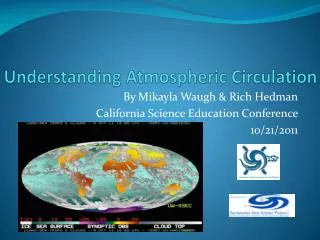
Winds over the Pacific on two days in Sept 1996 Stronger winds in red- orange Notes: Deviates from 6-cell model Strong westerlies hitting Canada Strong tradewinds (easterlies) over Hawaii Extratropical cyclone east of New Zealand
Circulation of the Atmosphere • Most of the variation from the 6-cell model is due to • Geographical distribution of landmasses • Different response of land and ocean to solar heating • Chaotic flow • Over long term – 6-cell model is pretty good for describing average flow
Major surface wind and pressure systems of the world and their weather • These wind patterns move 2/3 of heat from tropics to poles.
Monsoons • Pattern of wind circulation that changes with the season • Generally wet summers and dry winters • Linked to different heat capacities of land and water and to N-S movement of the ITCZ
Wet season • In the spring, land heats (faster than water) • Warm air over land rises creating low pressure • Cool air flows from ocean to land • This humid air heats and rises (rains form)
Dry Season • Land cools (faster than ocean) • Air cools and sinks over land creating high pressure • Dry surface wind moves seaward • Warms and rises over water (with or without evaporation and rain over water)
Monsoons • Most intense over Asia where you have a huge land mass in the N and a huge ocean to the S • Monsoon over India causes wet season (summer) from April – October (up to 10 meters – 425 inches of rain per year) • Smaller monsoon in N America (Gulf of Mexico and SE)
ITCZ Dry season Wet season ITCZ
Sea and Land breezes • Daily changes in wind direction due to unequal heating and cooling of land versus water • Warm air during day on land rises and cool air from sea moves onshore (with or without water vapor) • Warmer air over water rises and cool air on land during the night sinks and moves offshore
Daytime Onshore Breeze Nighttime Offshore Breeze
Take home points • Major latitudnal cells and their approximate boundaries • N-S and E-W variation in cell circulation • Air movements at cell boundaries versus within cells • Heating and cooling of air masses • How distribution of land and water affect air movement • Monsoons and onshore-offshore wind patterns