Download

1 / 40
400 likes | 536 Vues
This article provides an overview of Bayesian Networks, a powerful tool for modeling complex problem domains using a set of variables. By representing joint probabilities and exploiting conditional independence, Bayesian Networks simplify the construction and inference processes. Through the Alarm example, readers will learn how to estimate probabilities of events based on observed indications and how graphical representations illustrate the relationships among variables. The article also highlights the importance of causal relationships in constructing networks.

E N D
Introduction • A problem domain is modeled by a list of variables X1, …, Xn • Knowledge about the problem domain is represented by a joint probability P(X1, …, Xn)
Introduction Example: Alarm • The story: In LA burglary and earthquake are not uncommon. They both can cause alarm. In case of alarm, two neighbors John and Mary may call • Problem: Estimate the probability of a burglary based who has or has not called • Variables: Burglary (B), Earthquake (E), Alarm (A), JohnCalls (J), MaryCalls (M) • Knowledge required to solve the problem: P(B, E, A, J, M)
Introduction • What is the probability of burglary given that Mary called, P(B = y | M = y)? • Compute marginal probability:P(B , M) = E, A, J P(B, E, A, J, M) • Use the definition of conditional probability • Answer:
Introduction • Difficulty: Complexity in model construction and inference • In Alarm example: • 31 numbers needed • Computing P(B = y | M = y) takes 29 additions • In general • P(X1, … Xn) needs at least 2n – 1numbers to specify the joint probability • Exponential storage and inference
Conditional Independence • Overcome the problem of exponential size by exploiting conditional independence • The chain rule of probabilities:
Conditional Independence • Conditional independence in the problem domain:Domain usually allows to identify a subset pa(Xi) µ {X1, …, Xi – 1} such that given pa(Xi), Xi is independent of all variables in {X1, …, Xi - 1} \ pa{Xi}, i.e. P(Xi | X1, …, Xi – 1) = P(Xi | pa(Xi))Then
Conditional Independence • As a result, the joint probability P(X1, …, Xn) can be represented as the conditional probabilities P(Xi | pa(Xi)) • Example continued:P(B, E, A, J, M) =P(B)P(E|B)P(A|B,E)P(J|A,B,E)P(M|B,E,A,J) =P(B)P(E)P(A|B,E)P(J|A)P(M|A) • pa(B) = {}, pa(E) = {}, pa(A) = {B, E}, pa{J} = {A}, pa{M} = {A} • Conditional probability table specifies: P(B), P(E), P(A | B, E), P(M | A), P(J | A)
Conditional Independence As a result: • Model size reduced • Model construction easier • Inference easier
B E A J M Graphical Representation • To graphically represent the conditional independence relationships, construct a directed graph by drawing an arc from Xj to Xi iff Xj pa(Xi) • pa(B) = {}, pa(E) = {}, pa(A) = {B, E}, pa{J} = {A}, pa{M} = {A}
B E A J M Graphical Representation • We also attach the conditional probability table P(Xi | pa(Xi)) to node Xi • The result: Bayesian network P(B) P(E) P(A | B, E) P(J | A) P(M | A)
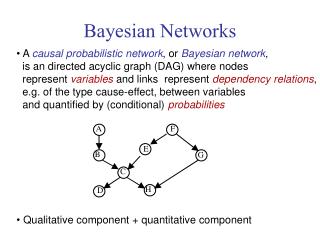
Formal Definition A Bayesian network is: • An acyclic directed graph (DAG), where • Each node represents a random variable • And is associated with the conditional probability of the node given its parents
B E A J M Intuition A BN can be understood as a DAG where arcs represent direct probability dependence • Absence of arc indicates probability independence: a variable is conditionally independent of all its nondescendants given its parents • From the graph: B ? E, J ? B | A, J ? E | A
Construction Procedure for constructing BN: • Choose a set of variables describing the application domain • Choose an ordering of variables • Start with empty network and add variables to the network one by one according to the ordering
Construction • To add i-th variable Xi: • Determine pa(Xi) of variables already in the network (X1, …, Xi – 1) such thatP(Xi | X1, …, Xi – 1) = P(Xi | pa(Xi))(domain knowledge is needed there) • Draw an arc from each variable in pa(Xi) to Xi
M J B M E J A A E B J M E A B Example • Order: B, E, A, J, M • pa(B)=pa(E)={}, pa(A)={B,E}, pa(J)={A}, pa{M}={A} • Order: M, J, A, B, E • pa{M}={}, pa{J}={M}, pa{A}={M,J}, pa{B}={A}, pa{E}={A,B} • Order: M, J, E, B, A • Fully connected graph
B M E J A E J M A B Construction Which variable order? • Naturalness of probability assessmentM, J, E, B, A is bad because of P(B | J, M, E) is not natural • Minimize number of arcsM, J, E, B, A is bad (too many arcs), the first is good • Use casual relationship: cause come before their effects M, J, E, B, A is bad because M and J are effects of A but come before A VS
Casual Bayesian Networks • A causal Bayesian network, or simply causal networks, is a Bayesian network whose arcs are interpreted as indicating cause-effect relationships • Build a causal network: • Choose a set of variables that describes the domain • Draw an arc to a variable from each of its direct causes (Domain knowledge required)
Example Smoking Visit Africa Lung Cancer Bronchitis Tuberculosis Tuberculosis orLung Cancer X-Ray Dyspnea
Causality is not a well understood concept. No widely accepted denition. No consensus on whether it is a property of the world or a concept in our minds Sometimes causal relations are obvious: Alarm causes people to leave building. Lung Cancer causes mass on chest X-ray. At other times, they are not that clear. Doctors believe smoking causes lung cancer but the tobacco industry has a different story: Casual BN Surgeon General (1964) S C Tobacco Industry * S C
Inference • Posterior queries to BN • We have observed the values of some variables • What are the posterior probability distributions of other variables? • Example: Both John and Mary reported alarm • What is the probability of burglary P(B|J=y,M=y)?
Inference • General form of query P(Q | E = e) = ? • Q is a list of query variables • E is a list of evidence variables • e denotes observed variables
Inference Types • Diagnostic inference: P(B | M = y) • Predictive/Casual Inference: P(M | B = y) • Intercasual inference (between causes of a common effect) P(B | A = y, E = y) • Mixed inference (combining two or more above) P(A | J = y, E = y) (diagnostic and casual) • All the types are handled in the same way
Naïve Inference Naïve algorithm for solving P(Q|E = e) in BN • Get probability distribution P(X) over all variables X by multiplying conditional probabilities • BN structure is not used, for many variables the algorithm is not practical • Generally exact inference is NP-hard
Inference • Though generally exact inference is NP-hard, in some cases the problem is tractable, e.g. if BN has a (poly)-tree structure efficient algorithm exists(a poly tree is a directed acyclic graph in which no two nodes have more than one path between them) • Another practical approach: Stochastic Simulation
A general sampling algorithm • For i = 1 to n • Find parents of Xi (Xp(i, 1), …, Xp(i, n) ) • Recall the values that those parents where randomly given • Look up the table for P(Xi | Xp(i, 1)= xp(i, 1), …, Xp(i, n)= xp(i, n) ) • Randomly set xi according to this probability
Stochastic Simulation • We want to know P(Q = q| E = e) • Do a lot of random samplings and count • Nc: Num. samples in which E = e • Ns: Num. samples in which Q = q and E = e • N: number of random samples • If N is big enough • Nc / N is a good estimate of P(E = e) • Ns / N is a good estimate of P(Q = q, E = e) • Ns / Nc is then a good estimate of P(Q = q | E = e)
Parameter Learning X2 X1 • Example: • given a BN structure • A dataset • Estimate conditional probabilities P(Xi | pa(Xi)) X4 X3 X5 ? means missing values
Parameter Learning • We consider cases with full data • Use maximum likelihood (ML) algorithm and bayesian estimation • Mode of learning: • Sequential learning • Batch learning • Bayesian estimation is suitable both for sequential and batch learning • ML is suitable only for batch learning
ML in BN with Complete Data • n variables X1, …, Xn • Number of states of Xi: ri = |Xi| • Number of configurations of parents of Xi: qi = |pa(Xi)| • Parameters to be estimated: ijk=P(Xi = j | pa(Xi) = k), i = 1, …, n; j = 1, …, ri; k = 1, …, qi
X2 X1 X3 ML in BN with Complete Data Example: consider a BN. Assume all variables are binary taking values 1, 2. ijk=P(Xi = j | pa(Xi) = k) Number of parents configuration
ML in BN with Complete Data • A complete case: Dl is a vector of values, one for each variable (all data is known).Example: Dl = (X1 = 1, X2 = 2, X3 = 2) • Given: A set of complete cases: D = {D1, …, Dm} • Find: the ML estimate of the parameters
X2 X1 X3 ML in BN with Complete Data • Loglikelihood:l( | D) = log L( | D) = log P(D | ) = log l P(Dl | ) = l log P(Dl | ) • The term log P(Dl | ): • D4 = (1, 2, 2) log P(D4 | ) = log P(X1 = 1, X2 = 2, X3 = 2 | ) = log P(X1=1 | ) P(X2=2 | ) P(X3=2 | X1=1, X2=2, )= log 111 + log 221 + log 322 • Recall: ={111,121,211,221,311,312,313,314,321,322,323, 324}
X2 X1 X3 ML in BN with Complete Data • Define the characteristic function of Dl: • When l = 4, D4 = {1, 2, 2}(1,1,1:D4)= (2,2,1:D4)= (3,2,2:D4)=1,(i, j, k: D4) = 0 for all other i, j, k • So, log P(D4 | ) = ijk(i, j, k: D4) log ijk • In general, log P(Dl | ) = ijk(i, j, k: Dl) log ijk
ML in BN with Complete Data • Define: mijk = l(i, j, k: Dl)the number of data cases when Xi = j and pa(Xi) = k • Then l( | D) = l log P(Dl | ) = li, j, k(i, j, k : Dl) log ijk=i, j, kl(i, j, k : Dl) log ijk=i, j, k mijk log ijk =i,kj mijk log ijk
ML in BN with Complete Data • We want to find:argmax l(| D) = argmax i,kj mijk log ijk ijk • Assume that ijk = P(Xi = j | pa(Xi) = k) is not related to i’j’k’ provided that i i’ OR k k’ • Consequently we can maximize separately each term in the summation i, k[…] argmax j mijk log ijkijk
ML in BN with Complete Data • As a result we have: • In words, the ML estimate for ijk = P( Xi = j | pa(Xi) = k) isnumber of cases where Xi=j and pa(Xi) = k number of cases where pa(Xi) = k
More to do with BN • Learning parameters with some values missing • Learning the structure of BN from training data • Many more…
References • Pearl, Judea, Probabilistic Reasoning in Intelligent Systems: Networks of Plausible Inference, Morgan Kaufmann, San Mateo, CA, 1988. • Heckerman, David, "A Tutorial on Learning with Bayesian Networks," Technical Report MSR-TR-95-06, Microsoft Research, 1995. • www.ai.mit.edu/~murphyk/Software • http://www.cs.ubc.ca/~murphyk/Bayes/bnintro.html • R. G. Cowell, A. P. Dawid, S. L. Lauritzen and D. J. Spiegelhalter. "Probabilistic Networks and Expert Systems". Springer-Verlag. 1999. • http://www.ets.org/research/conferences/almond2004.html#software