
SlideServe
Menu
Préférences
© SlideServe · v2026

ADDRESSING MODES

luke-griffin avatar
6 diapositives · 719 Views · Oct 31, 2014

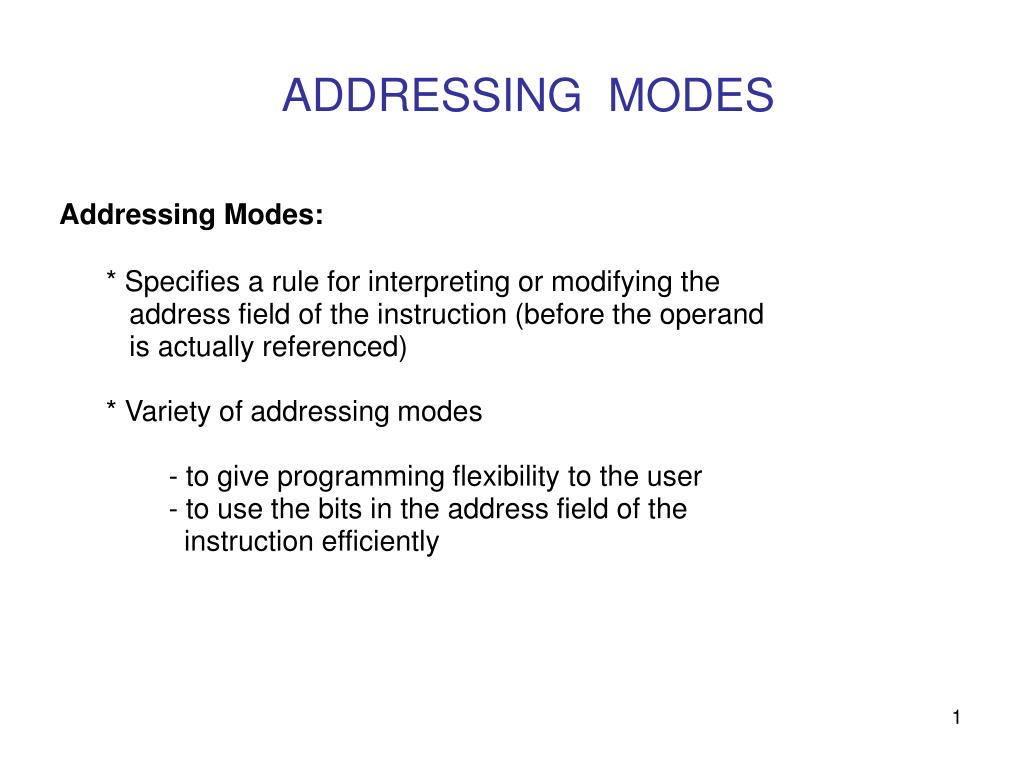
ADDRESSING MODES. Addressing Modes: * Specifies a rule for interpreting or modifying the address field of the instruction (before the operand is actually referenced) * Variety of addressing modes - to give programming flexibility to the user
ADDRESSING MODES - slide 1
01 / 6ADDRESSING MODES
1 / 17

Télécharger la présentation

ADDRESSING MODES
Une image / un lien ci-dessous est fourni (tel quel) pour télécharger la présentation

Politique de téléchargement : le contenu du site vous est fourni TEL QUEL pour votre information et votre usage personnel ; il ne peut être vendu, concédé sous licence ni partagé sur d’autres sites sans l’accord de son auteur.Le contenu vous est fourni TEL QUEL, pour votre information et votre usage personnel uniquement. Téléchargez la présentation en cliquant sur ce lien. Lors du téléchargement, si vous ne parvenez pas à télécharger une présentation, l’éditeur a peut-être supprimé le fichier de son serveur.Pendant le téléchargement, si vous ne parvenez pas à obtenir une présentation, le fichier a peut-être été supprimé par l’éditeur.

F I N

Plus de contenu associé

Transcription de la présentation
  1. ADDRESSING MODES Addressing Modes: * Specifies a rule for interpreting or modifying the address field of the instruction (before the operand is actually referenced) * Variety of addressing modes - to give programming flexibility to the user - to use the bits in the address field of the instruction efficiently

  2. TYPES OF ADDRESSING MODES Implied Mode Address of the operands are specified implicitly in the definition of the instruction - No need to specify address in the instruction - EA = AC EA: Effective Address. Immediate Mode Instead of specifying the address of the operand, operand itself is specified - No need to specify address in the instruction - However, operand itself needs to be specified - Sometimes, require more bits than the address - Fast to acquire an operand - Useful for registers initialization Register Mode Address specified in the instruction is the register address - Designated operand need to be in a register - Shorter address than the memory address - Saving address field in the instruction - Faster to acquire an operand than the memory addressing - EA = IR(R) (IR(R): Register field of IR)

  3. TYPES OF ADDRESSING MODES Register Indirect Mode Instruction specifies a register which contains the memory address of the operand - Saving instruction bits since register address is shorter than the memory address - Slower to acquire an operand than both the register addressing or memory addressing - EA = [IR(R)] ([x]: Content of x) Auto-increment or Auto-decrement features: Same as the Register Indirect, but: - When the address in the register is used to access memory, the value in the register is incremented or decremented by 1 (after or before the execution of the instruction)

  4. TYPES OF ADDRESSING MODES Direct Address Mode Instruction specifies the memory address which can be used directly to the physical memory - Faster than the other memory addressing modes - Too many bits are needed to specify the address for a large physical memory space - EA = IR(address), (IR(address): address field of IR) Indirect Addressing Mode The address field of an instruction specifies the address of a memory location that contains the address of the operand - When the abbreviated address is used, large physical memory can be addressed with a relatively small number of bits - Slow to acquire an operand because of an additional memory access - EA = M[IR(address)]

  5. TYPES OF ADDRESSING MODES Relative Addressing Modes The Address fields of an instruction specifies the part of the address (abbreviated address) which can be used along with a designated register to calculate the address of the operand PC Relative Addressing Mode(R = PC) - EA = PC + IR(address) - Address field of the instruction is short - Large physical memory can be accessed with a small number of address bits Indexed Addressing Mode XR: Index Register: - EA = XR + IR(address) Base Register Addressing Mode BAR: Base Address Register: - EA = BAR + IR(address)

  6. ADDRESSING MODES - EXAMPLES Address Memory 200 Load to AC Mode Address = 500 PC = 200 201 202 Next instruction R1 = 400 399 450 XR = 100 400 700 AC 500 800 600 900 Addressing Mode Effective Address Content of AC • Direct address 500 /* AC  (500) */ 800 • Immediate operand - /* AC  500 */ 500 • Indirect address 800 /* AC  ((500)) */ 300 • Relative address 702 /* AC  (PC+500) */ 325 • Indexed address 600 /* AC  (XR+500) */ 900 • Register - /* AC  R1 */ 400 • Register indirect 400 /* AC  (R1) */ 700 • Autoincrement 400 /* AC  (R1)+ */ 700 • Autodecrement 399 /* AC  -(R1) */ 450 702 325 800 300