Download
1 / 65
650 likes | 803 Vues
The Scientific Revolution and the Enlightenment marked pivotal shifts in human thought from the 16th to the 18th centuries. Beginning in the 1600s, figures like Copernicus, Kepler, and Galileo challenged outdated views of the universe with heliocentric and elliptical models. Philosophers such as Bacon and Descartes propagated the scientific method and reason. Meanwhile, Newton's laws of physics established foundational concepts in gravity and calculus. This period fostered an interest in science among the public, reshaping views on law, politics, and society.

E N D
Scientific Revolution and Enlightenment Chris Anderson Randolph-Henry H. S.
Most scientific theories were outdated: • Believed Earth to be flat • Earth was the center of the universe • Science began to change in the 1600s • New technology developed (microscope and telescope)
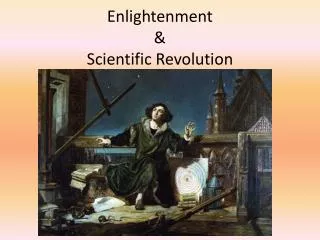
Astronomy • 1.) Nicolaus Copernicus: • Polish astronomer • Worked at University of Krakow in 1492 • Believed earth to be round • Heliocentricview of universe • Believed the ______________to be center of the universe • Never proved his theory • Since he was Catholic, he did NOT publish his ideas
2.) Johannes Kepler: • Skilled mathematician • Used math to provethat the Earth travels around Sun • Also proved the other planets travel around the sun • Planets use ellipticalorbits—not circular • Although Protestant, still afraid to publish
3.) Galileo Galilei: • 1609: created his telescope • Discovered moons around Jupiter (Galilean Moons) • Proves that a body can travel around another body • 1632: Published his ideas • Catholic Church did NOT like his book • He was placed on trial • He recanted his ideas even though he knew he was right • Placed under house arrest for the rest of his life • Continued to work in science • Created the Universal Laws of Physics
Philosophy • 1.) Francis Bacon: • English Philosopher • Information not based on proven fact should be thrown out • Believed in using the scientific method
2.) Rene Descartes: • French Philosopher and mathematician • Only way to reach truth is through reason • Invented analytic geometry
3.) Sir Isaac Newton: • Physicist from England (tell story) • Believed in scientific method • 1687: wrote Mathematical Principles of Natural Philosophy • The book explained his ideas on gravity and universal gravitation (why the planets move) • Invented Calculus
Biology, Medicine, Anatomy • 1.) Andreas Vesalius: • French medical student • Illegally dissected dead humans (tell story) • Contributed a lot to the study of anatomy
2.) William Harvey: • English doctor • Discovered how blood circulates through the body
3.) Robert Hooke: • Englishman • Discovered the _________________ • Used the microscope to make his discovery • What type of material did he look at to make his discovery???
Chemistry • 1.) Robert Boyle: • Irishman • Turned chemistry into a pure science (tell story about alchemy) • Defined element—any substance that cannot be broken down into smaller parts
2.) Joseph Priestly: • English chemist and preacher • Studied air • Discovered Oxygen • Discovered carbon dioxide (CO2) • What did his discovery of CO2 help to develop????
3.) Antoine Lavosier: • French Chemist • Studied Oxygen • Burning objects consume oxygen—Nature of Combustion
Common people in Europe became interested in science • Began conducting scientific experiments at home • People began to believe that everything could be explained by using the scientific method (law, politics, economics, social relationships, etc.)
Thomas Hobbes: • Believed that an absolute monarchy was the best form of government • Without an absolute monarch, a nation would fall apart • Believed humans are naturally inclined to become violent and disorderly (discuss) • Believed people do NOT have the right to rebel against the government • 1651: wrote Leviathan about a fictional place without a government
John Locke: • Believed the government should be based on a contract and order needed to be established (What type of contract???) • Believed humans to be naturally moral and reasonable (Who was right??) • People have rights to: • Life • Liberty • Property Ever heard of these before???
Believed people COULD rebel against their government if the government took away their rights • 1690: wrote Two Treatises of Government • Lots of people in the American colonies read Locke’s book • Used Locke’s ideas as the basis for the American Revolution • Jefferson used Locke’s ideas in the Declaration of Independence
Hugo Grotius • Dutch jurist • Wanted international law to be based on natural law
William Penn • Founded the Quaker Colony in Pennsylvania • Pacifism
Deism • Religious philosophy that says no one religious philosophy is true • Do not believe in organized religion • Very popular in America and Europe • Most of America’s founding fathers where deist
Age of Enlightenment • Occurred during the late 17th and 18th centuries • People see the world as they have never seen it before • Classification of animals, insects, and plants • See the universe as a machine with fixed laws
Philosophes (Philosophers) • Thinkers of the Enlightenment • Believe in Locke’s and Newton’s ideas • Dislike superstition • Like freedom of speech and people’s right to liberty • Wrote lots of books
France—active center for the Enlightenment • Salons—places where thinkers would gather to share ideas • Madame de Pompadour—famous French lady who ran a popular salon in Paris
Encyclopedie • The most important accomplishment of the Enlightenment • Published in 1751 • 28 volumes about everything known in the world (3000 pages long) • Started as a French translation of an English _____________________ • Denis Diderot—editor of Encyclopedie • Goes to prison defending the work
Montesquieu (Charles-Louis de Secondat, Baron de Montesquieu) • Helped Diderot with the Encyclopedie • 1748: wrote Spirit of Laws • Liked England’s government • Believed in 3 branches of government equally sharing power • 1.) Legislative • 2.) Executive • 3.) Judicial Ever heard of these???