Download
1 / 26
260 likes | 368 Vues
Explore the dynamic shifts in European society during the Scientific Revolution and Enlightenment. Witness the clash between traditional beliefs and modern theories, the rise of individual rights, and the emergence of capitalism and secularization. Dive into the impact of key figures like Kepler, Galileo, and Newton, and grasp the core principles of the Enlightenment. Discover how these forces shaped politics, economics, justice, education, and more, leading Europe into a new era of progress and change. ###

E N D
Forces for Change in Europe • Renaissance – Humanism (individualism) and Secularization • Discovery of the Americas • 200 years of church decline • Growth of national monarchies • Emergence of capitalism and an independent merchant class
Medieval Worldview • Authoritarian – religious (Church) and secular (King) • Theocratic – rule by God’s agents, Top-down • Theocentric-all life and thought revolves around the church
Influence of the “New Thought” on other fields of thought • Political Thought – Locke and Hobbes HobbesLocke Nature of Man passions reason State of nature war inconvenience Social Contract surrender of surrender of all power to some power to a sovereign a government (absolutism) (constitutionalism) Alternative none revolution
The Copernican Universe • Reconception of the Universe • Reliance on 2nd-century Greek scholar Claudius Ptolemy of Alexandria • Motionless earth inside nine concentric spheres • Christians understand heaven as last sphere • Difficulty reconciling model with observed planetary movement • 1543 Nicholas Copernicus of Poland breaks theory • Notion of moving Earth challenges Christian doctrine
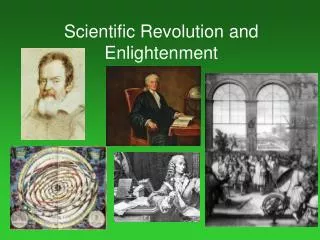
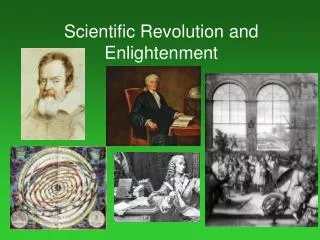
The Scientific Revolution Johannes Kepler (Germany, 1571-1630) and Galileo Galilei (Italy, 1564-1642) reinforce Copernican model Isaac Newton (1642-1727) “Principia Mathematica” 1687 - theory of gravity “he found a hodgepodge of isolated facts and laws. . .and left us a unified system of laws capable of application to an enormous range of physical phenomena.” Rigorous challenge to church doctrines
Traditional vs. Modern Views of • Knowledge • Humans • Nature • God/The Church
The Enlightenment – The Age of Reason “The political history of the Western world since the 18th century has been dominated by the notion of individual rights.”
Medieval View of Rights • -ordained by birth or status Ex. aristocracy = social organization • -fixed by custom or tradition, depending on one’s place in the social hierarchy • -group privileges, not individual rights • -ordained by God – “divine rights” monarchy (absolutism) = political organization • -religion affirmed traditional roles
Core Principles of Enlightenment “the science of human beings” • 1. Reason – “self-evident” • 2. Natural Law – universal • 3. Progress – “a paradise on earth”
The Theory of Progress • Assumption that Enlightenment thought would ultimately lead to human harmony, material wealth. • Decline in authority of traditional organized religion. “Humans, through reason, could discover the natural laws of human society, which, when applied, would lead to a “paradise on earth.”
Philosophes – public intellectuals(Montesquieu, Voltaire, Rousseau) “The philosophers have only interpreted the world, the point is to change it” Propagandists Social activists 1751 Encyclopédie – accumulation of the new scientific worldview, the “clockwork universe”
Deism, the Natural Religion • -God the creator, the “clockmaker” • -God has revealed himself through nature • - religious freedom - “My mind is my own church” • -separation of church and state • -Voltaire “ecrasez l’infame” – opposed to organized religion • -natural morality – humans good by nature Was Tom Paine an atheist?
Economics • Adam Smith, The Wealth of Nations, 1776 -basic principles of capitalism • private property • individual self-interest • the market, free enterprise • supply and demand “the invisible hand” • laissez-faire – no government interference • free trade • wealth measured by total productivity of the society
Law and Justice Beccaria, Italian 1761 treatise • more humane treatment of criminals • abolish capital punishment • no torture • punishment should fit the crime • rehabilitation rather than punishment • prevention of crime rather than punishment
Education • Rousseau – education should be natural, “back to nature,” the modern concept of childhood • Locke – “tabula rasa” - empiricism (relying on sense experiences to determine reality) • liberal arts • training for citizenship • public, secular education • humans are rational
Politics • -popular sovereignty-power for government comes from the people • -representative government – democracy • -constitutionalism • -individual rights (civil rights) • -equality • -separation of powers/checks and balances
Ancien Regime “Evils” Mercantilism Absolutism Aristocracy The Church Slavery
Louis XIV (The “Sun King,” 1643-1715) • L’état, c’est moi: “I am the state.” • Magnificent palace at Versailles, 1670s, becomes his court • Largest building in Europe • 1,400 fountains • 25,000 fully grown trees transplanted • Power centered in court, important nobles pressured to maintain presence