Download
1 / 14
150 likes | 286 Vues
This guide explores the Earth's grid system using latitude and longitude to describe locations. Latitude measures the distance north or south of the Equator, while longitude measures east or west of the Prime Meridian. The Equator and Prime Meridian serve as starting points, with latitude lines running parallel and longitude lines converging at the poles. Important latitudinal lines include the Arctic Circle and Tropic of Cancer, while the International Date Line marks 180° longitude. Together, these coordinates provide an absolute location on Earth, designated in degrees, minutes, and seconds.

E N D
Latitude and Longitude Another type of grid system
Another Grid Type • If the Earth were flat, rectangular coordinates (x, y) would be sufficient to describe the locations of points on its surface. However, the Earth is a sphere with no sides, and a special frame of reference is needed. The poles of the Earth provide this reference frame.
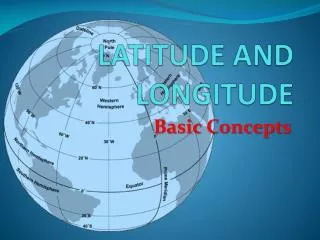
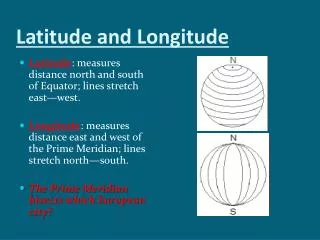
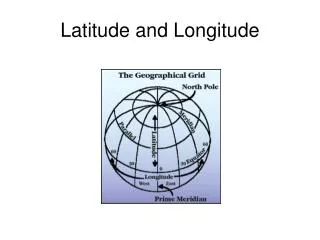
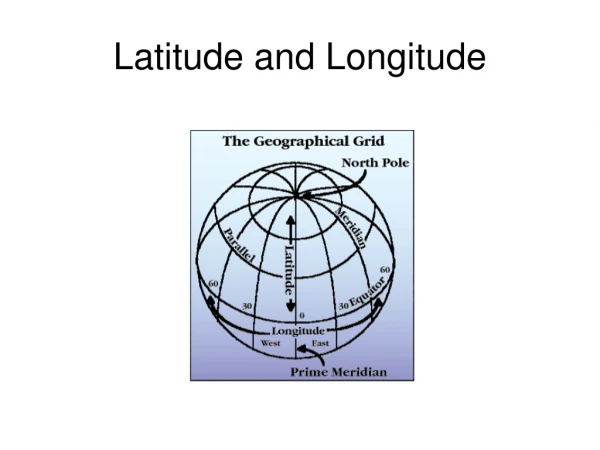
Latitude • Latitude measures the angular distance of places north and south of the Equator
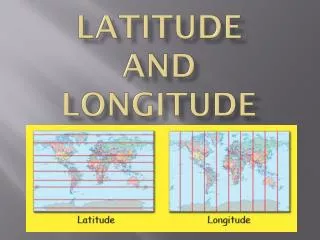
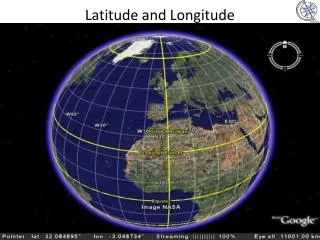
Latitude • Are imaginary, horizontal lines. • The Equator is the starting point for lines of latitude (0). • Measure the distance North & South of the Equator. • Lines are drawn around the earth, parallel to the Equator. • Lines never intersect with each other. • Lines are approximately 111km apart. • Lines are used as political boundaries
Latitude • Equator – an imaginary line that divides the Earth into 2 equal parts (Northern & Southern hemispheres).
Important Lines of Latitude • Arctic Circle -66.5°N • Tropic of Cancer -23.5 °N • Equator -0° • Tropic of Capricorn -23.5°S • Antarctic Circle -66.5°S
Longitude • Longitude measures the angular distance of places east and west of the Prime Meridian
Longitude • Are imaginary, vertical lines. • The Prime Meridian is the starting point for lines of longitude (0). • The International Date Line is the 180 meridian. • Measure the distance East and West of the Prime Meridian. • Lines are drawn from the North Pole to the South Pole. • Lines converge at the poles and are furthest apart at the Equator. • Lines are used to determine time zones
Longitude • Prime Meridian – an imaginary line that divides the Earth into 2 equal parts (Eastern & Western hemispheres).
Absolute Location • ABSOLUTE LOCATION • The location of a point on the Earth using latitude and longitude lines. • Using the latitude and longitude grid, we can pinpoint any place on the Earth. This location is specified by a series of numbers – degrees, minutes, seconds (i.e. 44 25’ 14”).
Latitude and Longitude Important Points to Remember: • Be sure to give latitude reference always first then longitude • Don’t forget to add the degree symbol and the N,S,E,W reference to each latitude and longitude reference number • Remember that both latitude and longitude lines are curved lines, to find a degree reference you must follow a curved path not a straight one • Remember that longitude lines spread apart as they move away from the poles, adjust your degree reference to accommodate for that