Download
1 / 10
100 likes | 240 Vues
This overview explores the characteristics and processes associated with destructive plate margins, specifically focusing on continental-continental collisions. Key landforms include fold mountains, thrust faults, and gneiss formation, alongside phenomena like regional metamorphism and shallow-focus earthquakes. We differentiate these processes from oceanic-oceanic and oceanic-continental collisions, highlighting their negligible volcanism and extensive crustal thickening. Understanding these dynamics is crucial for comprehending the hazards posed by such geological boundaries, especially regarding earthquake risks and human safety.

E N D
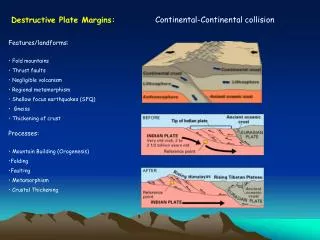
Destructive Plate Margins: Continental-Continental collision Features/landforms: • Fold mountains • Thrust faults • Negligible volcanism • Regional metamorphism • Shallow focus earthquakes (SFQ) • Gneiss • Thickening of crust Processes: • Mountain Building (Orogenesis) • Folding • Faulting • Metamorphism • Crustal Thickening
What are the main differences between Continent-Continent Collision and Oceanic-Oceanic/Oceanic–Continental Collision ? Continent-Continent Oceanic/Continent Negligible volcanism Volcanoes = andesitic rock Shallow Earthquakes Deep and Shallow Earthquakes Extensive granite generation and regional metamorphism Minor granite generation and localised metamorphism Extensive shortening of continental crust – associated thrust faulting Extensive shortening of oceanic crust – localised thrust faulting
Conservative Plate Margins: Features/landforms: • Shallow focus earthquakes (SFQ) • Fault scarps • Lateral fault movement • Tear/wrench fault (Strike/Slip) • Fault zone • San Andreas Fault Processes: • Lateral plate movement • Pressure build up • Stress release • Fault Displacement
Why are conservative margins so hazardous to humans ? Plate Boundaries
Characteristics of Plates LITHOSPHERE
Plate Tectonics Assessment Plate Tectonics Assessment – For Monday Morning ALL homework to be handed on Monday morning