Download
1 / 22
220 likes | 353 Vues
The history of the periodic table traces its evolution from Lavoisier's list of 28 elements in the late 18th century to the modern classification system established by Dmitri Mendeleev and Henry Moseley. Key developments include Dalton's early 19th century list, Döbereiner's triads, and Newlands' octaves, culminating in a periodic organization based on atomic numbers. Significant contributions from Glenn Seaborg, including the discovery of transuranium elements and the reconfiguration of the table, highlight the ongoing advancements in chemistry and our understanding of elemental properties.

E N D
Late 18th century: Lavoisier's list of 28 elements • Early 19th century: John Dalton's list of approximately 60 elements • Döbereiner's "triads" of elements with related or similar properties; e.g., Ca, Sr and Ba • John Newlands "octaves" or groups of eight elements after which properties seemed to repeat Early History
(Julius) LotharMeyer (1830 – 1895) German chemist who, independently of Dmitri Mendeleev, developed a periodic classification of the chemical elements. Though originally educated as a physician, he was chiefly interested in chemistry and physics.
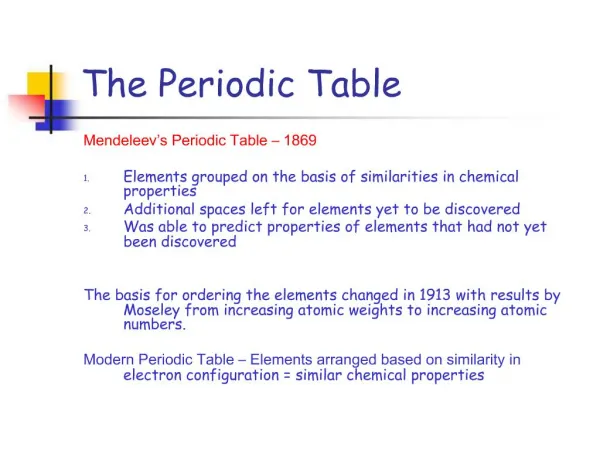
Began working on his periodic table of the elements in the late 1860s. • Arranged the known 63 elements by their atomic weights and organized them into groups possessing similar properties. • Where there were gaps, he correctly predicted the properties for the undiscovered elements (gallium, scandium and germanium). DIMITRIMENDELEEV (1834-1907)
Henry Moseley (1887-1915) • Established the concept of atomic numbers. • Showed that the ordering of the wavelengths of the x-ray emissions of the elements coincided with the ordering of the elements by atomic number(1913). • Developed periodic table based on atomic number.
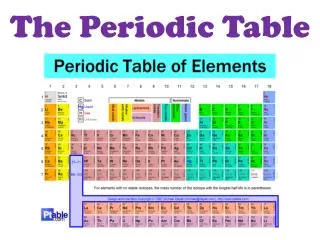
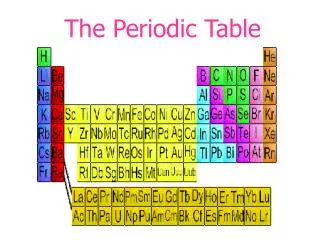
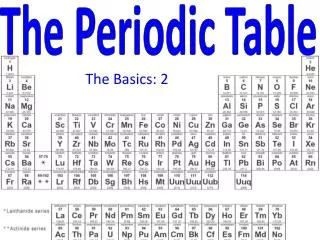
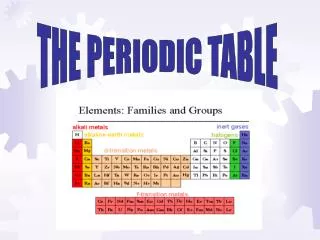
PERIODIC LAW PROPERTIES OF ELEMENTS ARE PERIODIC FUNCTIONS OF THEIR ATOMIC NUMBERS
GLENN SEABORG (1912-1999) • starting with plutonium in 1940, he discovered all the transuranium elements from 94 to 102 • reconfigured the periodic table by placing the actinide series below the lanthanide series • in 1951, Seaborg was awarded the Nobel Prize in chemistry for his work. Element 106 has been named seaborgium (Sg) in his honor.
Properties of Major Divisions Metals • lusterous, shiny • typically solids at room temperature (except Hg, Cs) • good conductors of heat and electricity • malleable and ductile • tend to lose electrons easily (form cations)
Properties of Major Divisions Nonmetals • do not have a metallic luster • poor conductors of heat and electricity • may be solid, liquid or gas at room temperature (majority are gases) • non malleable, non ductile • tend to gain electrons easily (form anions)
Properties of Major Divisions Semi-metals (metalloids) have properties that are intermediate between metals and nonmetals.
Elmsley, John, The Elements,3rd Ed., Clarendon Press, Oxford,1998.Chemistry: Connections to Our Changing World, LeMay, et al., Prentice Hall, 1996.http://www.britannica.com/bcom/eb/article/5/0,5716,53705+1+52397,00.htmlhttp://www.crosswinds.net/~smarsden/unit04/l6u4.htmhttp://www.thirteen.org/archive/hawking/cosmostar/html/cstars_mendel.htmlhttp://www.sweethaven.com/chemele/pertab01.html BIBLIOGRAPHY