Understanding Weight, Mass, Volume, and Density in Matter Science
This lesson explores the fundamental concepts of weight and mass as measurements of matter. Weight is defined as the force of gravity acting on an object, while mass measures the amount of matter contained in it, remaining constant regardless of location. The International System of Units (SI) guides scientific measurements. Volume refers to the space occupied by matter, commonly using liters and cubic centimeters. Additionally, density relates mass to volume, impacting whether objects sink or float in water. Understanding these properties is essential in science.

Understanding Weight, Mass, Volume, and Density in Matter Science
E N D
Presentation Transcript
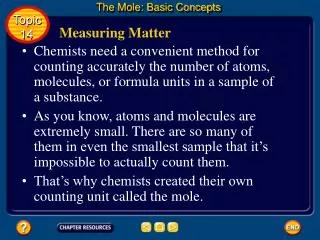
Measuring Matter Chemical Building Blocks Lesson 2 Chapter 1
Weight and Mass • Your weight is a measure of the force of gravity on you. On earth, all objects are attracted toward the center of the planet by the force of Earth’s gravity. • The mass of an object is the measurement of the amount of matter in an object. • Unlike weight, mass does not change with location, even when the force of gravity on an object changes.
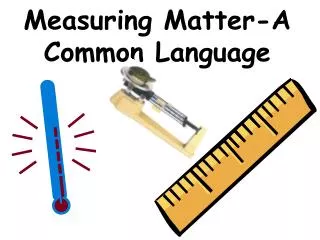
Units of Mass • To measure the properties of matter, scientists use a system called the International System of Units. The system is abbreviated “SI” after the French name, Systeme International.
Volume • The amount of space that matter occupies is called its volume. • Common units if volume include the liter (L), milliliter (mL) and the cubic centimeter (cm3) • The volumes of solid objects are usually expressed in cubic centimeters. To get the volume of regular shaped object you use the equation below. • Volume = Length x Width x Height • But how can you measure the volume of an irregular object such as a rock or piece of fruit? One way is to submerge the object in water in a graduated cylinder. The water will rise by an amount that is equal to the volume of the object in milliliters. This is known as displacement.
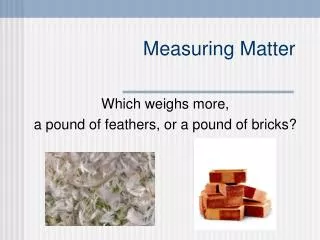
Density • Samples of two different materials may have the same volume, but they don’t necessarily have the same mass. Ex: which weigh more, a pound of feather or a pound of sand? The weigh the same because they are both a pound, but they have different densities. • Density relates the mass of a material in a given volume. • Density is an important property in all matter.
Suppose you have a solid block of wood and a solid block of iron. When you drop both blocks into a tub of water, you can see right away that the wood floats and the iron sinks. • The density of water is 1 g/cm3 • Objects with densities greater than water will sink and objects with lesser densities than that of water will float. • Density is a physical property of a substance.