Understanding Moles: The Key to Counting Particles in Chemistry
This section explores the concept of the mole, the SI unit for measuring the amount of substance, and its critical role in counting atoms, molecules, and formula units in chemistry. You'll learn to explain how a mole serves as a bridge between the microscopic world and everyday counting units, providing a method for converting between moles and the number of representative particles, also known as Avogadro's number. Practice problems will help reinforce your understanding of how to determine moles and particles in various chemical contexts.

Understanding Moles: The Key to Counting Particles in Chemistry
E N D
Presentation Transcript
Section 1: Measuring Matter Chemical Composition
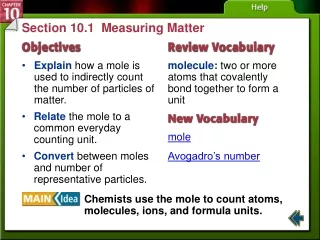
Learning Goals • Explain how a mole is used to indirectly count the number of particles of matter. • Relate the mole to a common everyday counting unit. • Convert between moles and number of representative particles.
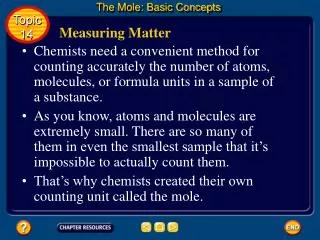
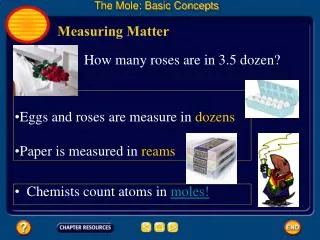
Counting Particles • Chemists need a convenient method for accurately counting the number of atoms, molecules, or formula units of a substance. • The mole is the SI base unit used to measure the amount of a substance.
Counting Particles • 1 mole is the amount of atoms in 12 g of pure carbon-12, or 6.02 x 10²³ representative particles • an atom, a molecule, a formula unit, an electron, an ion, etc. • The number is called Avogadro’s number.
Converting Between Moles and Particles • Moles to particles:
Converting Between Moles and Particles • Particles to moles
Practice • Determine the number of Zn atoms in 2.50 mol of Zn.
Practice • Calculate the number of molecules in 11.5 mol of water.
Practice • How many moles are in 5.75 x 1024 atoms of aluminum?
Practice • How many molecules of AgNO3 are there in 3.25 mol of AgNO3? How many atoms are there?