Research Update
This report outlines the progress of research conducted at the Seon Kim Laboratory at the University of Illinois at Chicago. It focuses on rigorous separation synthesis, detailing the exhaustive design of separation networks utilizing robust algorithms aimed at energy efficiency. Key topics include the integration of design and control for large-scale flowsheets, methodologies for network optimization using genetic algorithms and nonlinear programming, and the application of parametric interpolation techniques. The report also covers developments in biofuel separation research, computational methodologies, and updates from research activities.

Research Update
E N D
Presentation Transcript
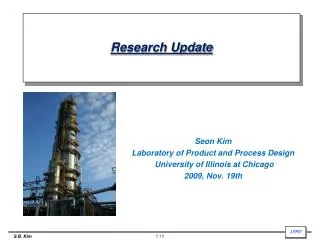
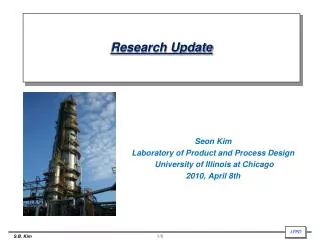
Research Update Seon Kim Laboratory of Product and Process Design University of Illinois at Chicago 2010, April 8th
Research Progress Semester Plan • Paper 4: Rigorous Separation Synthesis : Part II – Exhaustive / Comprehensive Network Design (100%) • ESCAPE Papers (100%) • Robust Thermodynamically-guided Algorithms for Synthesis of Energy Efficient Separation Networks • Integration of Design and Control for a large scale flowsheet • Draft report: Fully Automatic Energy Efficient complex Network Optimization (30%) • Optimization with GA solver • Optimization with NLP solver • Optimization with Parametric Interpolation • Refinery reference research • Biofuel separation reference research (20%) • REU/RET Activity • Computer hardware / Webpage maintenance
Research updates Weeks 9 to 10 • Parametric curve fitting to find minimum for the selected region of BPD • Matlab coding to find multiple surface of BPD for complex column • REU application review and selection status
Quadratic Spline Interpolation Quadratic spline curve of n-degree, n+1 real data points; P1=(1, 10) P2=(1.2, 5) P3=(3, 7) P1=(1, 10) P2=(2.8, 5) P3=(3, 7) P1=(1, 10) P2=(2, 5) P3=(3, 7)
Bezier Curve Bezier curve of n-degree, n+1 real data points; where, nCi is binomial coefficient, , and Pi are points Ex) Quadratic Bezier curve: Cubic Bezier curve : P1=(1, 10) P2=(1.5, 7) P3=(2, 5) P4=(2.5 6) P5=(3, 7) P1=(1, 10) P2=(1.5, 7) P3=(2, 5) P4=(3, 7) P1=(1, 10) P2=(2, 5) P3=(3, 7)
BPD BPT, oC reflux
Quadratic Spline Interpolation A A C BPD B B BPT, oC reflux C
Parametric polynomial root finding A C A B C' C BPD C' B BPT, oC reflux
Iteration 1 C A A' B C‘ C BPD A' C' B BPT, oC reflux
9 iterations to find mininum BPD • Stop criterion(ε) of Δr: 1e-4 A B' B C Stop criterion(ε) of Δr: 1e-4
A B A B C BPD BPT, oC reflux C
BPD BPT, oC reflux
Problem description • Non-convex problem • Non-derivative problem • Optimization Scheme • Non-convex optimization • Non-derivative optimization • Least update with real data • Global optimization with adaptive sampling and local optimizer • Adaptive sampling candidates • Controlled random search • Genetic Algorithm • Simulated annealing • Neural algorithm • Local optimizer candidates • Nelder & Mead Simplex method • Parametric quadratic polynomial root finding