Maintenance Strategies for Post-ITER Power Reactors: Insights from US-Japan Workshop
110 likes | 252 Vues
This document summarizes key findings from the Japan-US workshop on fusion power plants held in January 2005. It addresses maintenance issues surrounding the vacuum boundary, PF coil positioning, and offers innovative segmentation strategies for in-situ and hot cell maintenance of reactor components. The discussion includes the implications of maintainability on plasma performance and comparative analyses of maintenance approaches, emphasizing the importance of design choices in future reactor developments.


Maintenance Strategies for Post-ITER Power Reactors: Insights from US-Japan Workshop
E N D
Presentation Transcript
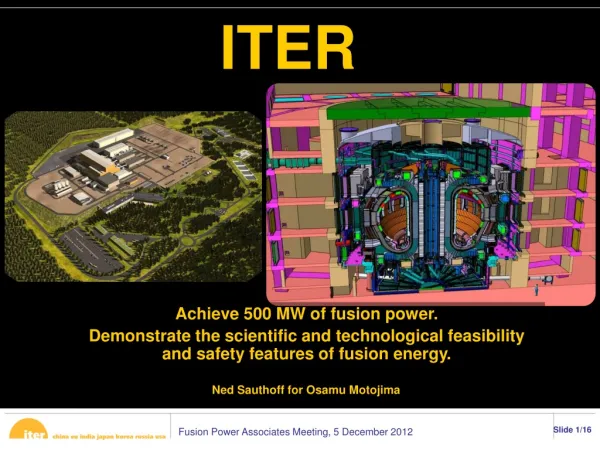
1/11 Maintenance Scheme for Post-ITER Power Reactors Japan-US Workshop on Fusion Power Plants and Related Advanced Technologies with participation of EU, January 11-13, 2005 at Tokyo, JAPAN S.NISHIO for Reactor Design Team JAERI ; Naka Fusion Research Establishment Naka-machi, Naka-gun Ibaraki-ken 311-0193, JAPAN Nishio@ naka.jaeri.go.jp
2/11 Maintenance Related Issues A maintenance issue inevitably includes a vacuum boundary topology issue and a PF coils positioning issue. Segmentation of Replaceable Components
3/11 Vacuum Boundary Topology Supporting System of Power Core Components
4/11 Small Module ( Ship-in-bottle ) Segmentation for In-Situ Maintenance (1) 4~5 tons
5/11 Segmentation for In-Situ Maintenance (2) Large Module 40~50 tons Reasonably moderate or Unsatisfactory half measures ?
6/11 Segmentation for Hot Cell Maintenance Hot Cell Maintenance ~300 tons
7/11 PF Coils Positioning Plasma Shaping Control (Ellipticity) K95 <~2.0
8/11 Maintainability vs. Plasma Performance Three Possible Concepts (1) In-Situ Maintenance & Higher Elliptic Plasma (2) Hot Cell Maintenance & Lower Elliptic Plasma (3) Hot Cell Maintenance & Higher Elliptic Plasma (but Replaceable PFCs)
Criteria (Importance) In-Situ Maintenance Hot Cell Maintenance 4 4 2 1 1 3 2 3 20 1 (4) 4 (16) 1 (4) 4 (16) 4 (8) 3 (6) 4 (4) 3 (3) 4 (4) 2 (2) 4 (12) 2 (6) 0 (0) 4 (8) 1 (3) 4 (12) 39/80 69/80 Maintenance Time Replacement Sector Reliability Building Cost Maintenance Equipment Cost Spare Equipment Cost Waste Volume Contamination Control Applicability to Scheduled and Unscheduled Maintenance 9/11 Qualitative Comparison of Maintenance Approaches (by L.M.Waganer)
18.2 m Simple Vacuum Boundary Simple Maintenance Scheme 10/11 Hot Cell Maintenance Approach Replacement Unit
11/11 Conclusion What can we do? Go back to the starting point. Try to find a guide into tomorrow by taking lesson from the past.