Exploring Human Nature: Good, Evil, or Just Is?
This text delves into the philosophical perspectives on human nature and its implications for society. It examines three viewpoints: Hobbes' belief in innate selfishness leading to chaos, Locke's rational approach advocating for personal freedom with government protection, and Rousseau's idea of natural goodness corrupted by larger societies. These philosophies shaped modern government, emphasizing the need for structure, laws, and community participation in maintaining order and addressing citizens' needs.

Exploring Human Nature: Good, Evil, or Just Is?
E N D
Presentation Transcript
Good? Evil? Just is? • Human nature is good: we innately want to do good things. • Human nature is evil: we innately want to do bad things. • Human nature just is: We are the products of our environments; humans have instinctual drives which are biologically predetermined.
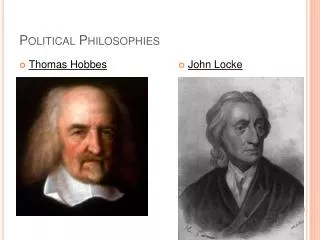
Thomas HobbesHe argued … • People naturally have selfish impulses. • In a community, these selfish impulses lead to chaos (human nature is naturally evil). • A strong leader is needed to discipline, control and manage society. • Type of government: Conservative (autocratic, dictatorship, monarchy).
John LockeHe argued… • People are born naturally rational. • Individuals willingly give up some personal freedoms in exchange for the promise that their freedoms will be protected by the government (like our constitution). • Type of government: Liberal/Moderate
Jean-Jacques RousseauHe argued… • People are born naturally free and peaceful. • This freedom and harmony is achieved through the ‘common good’ • The common good can only be achieved in small communities. • Human nature is essentially good, though large societies corrupt this goodness. • Type of government: Liberal
Who could have said this?? • “We need discipline in the classroom, strict rules and severe consequences to maintain order.” • “If we all work together, we will all be happy.” • “Living in communities serves the needs of people.” • “You know what? I’m willing to sacrifice a good mark on the presentation board, as long as I get a good mark overall.” • “As cities get larger, people become more corrupt.” • “A written set of rules is needed to maintain order, but the people should have a say in the making of these rules.” • “People only do things to benefit themselves.”
Because of these philosophies … Governments were created… Governments were created to: • look after the structures that provide important services to the population; • to create laws and to ensure such laws are respected; • some governments even try to make compromises to satisfy the multiple needs of their citizens.
Government is defined as … • "To Steer” (Latin Term) • “Manage the nation’s business” • A decision making system that has the right to make laws that directs a country, province or city.