Advances in Linear Programming: Deterministic and Randomized Algorithms
This lecture by Prof. Dr. Thomas Ottmann from the University of Freiburg covers the formulation of linear programming problems and discusses both deterministic and randomized algorithms to solve these problems. Topics include incremental algorithms, unbounded linear programs, and the structure of feasible regions in higher dimensions. The lecture also delves into the optimal vertex lemma and its implications for linear programs. With a focus on algorithms for computing optimal solutions, this session is a crucial resource for students and researchers in computational geometry and optimization.

Advances in Linear Programming: Deterministic and Randomized Algorithms
E N D
Presentation Transcript
Linear Programming Computational Geometry, WS 2006/07 Lecture 5, Part II Prof. Dr. Thomas Ottmann Algorithmen & Datenstrukturen, Institut für Informatik Fakultät für Angewandte Wissenschaften Albert-Ludwigs-Universität Freiburg
Overview • Problem formulation and example. • Incremental, deterministic algorithm. • Randomized algorithm. • Unbounded linear programs. • Linear programming in higher dimensions. Computational Geometry, WS 2006/07 Prof. Dr. Thomas Ottmann
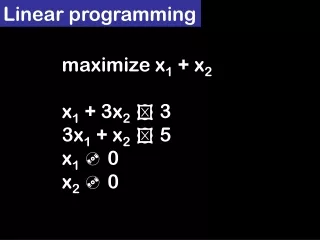
Linear program of dimension d: c = (c1,c2,...,cd) hi = {(x1,...,xd) ; ai,1x1 + ... + ai,dxd bi} Problem Description Maximize c1x1 + c2x2 + ... + cdxd Subject to the conditions: a1,1x1 + ... a1,dxd b1 a2,1x1 + ... a2,dxd b2 : : : an,1x1 + ... an,dxd bn li = hyperplane that bounds hi (straight lines, ifd=2) H = {h1, ... , hn} Computational Geometry, WS 2006/07 Prof. Dr. Thomas Ottmann
C C C Structure of Feasible Region 1. Bounded 2. Unbounded 3. Empty Computational Geometry, WS 2006/07 Prof. Dr. Thomas Ottmann
Bounded Linear Programs • Assumption : • Algorithm UnboundedLP(H, c) yields either • a ray inH, which is unbounded towards c, or • two half planes h1 and h2, so that h1 h2 is bounded towards c, or • the answer, that LP(H, c) has no solution, because the feasible region is empty. Computational Geometry, WS 2006/07 Prof. Dr. Thomas Ottmann
Incremental Algorithm Let C2 = h1 h2 Remaininghalfplanes: h3,..., hn Ci = Ci-1 hi = h1 ... hi Compute-optimal-vertex (H, c) v2 := l1 l2 ; C2 := h1 h2 for i := 3 to n do Ci := Ci-1 hi vi := optimal vertex of Ci C2C3 C4 ... Cn = C Ci = C = Computational Geometry, WS 2006/07 Prof. Dr. Thomas Ottmann
Optimal Vertex Lemma 1:Let2 < i n, then we have : 1.If vi-1 hi, then vi = vi-1. 2.If vi-1 hi, then either Ci = or vi li, where li is the line bounding hi. Computational Geometry, WS 2006/07 Prof. Dr. Thomas Ottmann
h4 h1 h3 v3= v4 h2 h4 h1 h3 c h5 c h2 v4 v5 Optimal Vertex Computational Geometry, WS 2006/07 Prof. Dr. Thomas Ottmann
Next Optimal Vertex fc(x) = c1x1 + c2x2 Ci-1 vi-1 Computational Geometry, WS 2006/07 Prof. Dr. Thomas Ottmann
Algorithm: 2D-LP Input: A 2-dimensional Linear Program (H, c ) Output: Either one optimal vertex or or a ray along which (H, c ) is unbounded. if UnboundedLP(H, c ) reports (H, c ) is unbounded or infeasible thenreturn UnboundedLP(H, c ) else report h1 := h; h2 := h´ ; v2 := l1 l2 let h3,...,hn be the remaining half-planes of H for i:= 3 to n do if vi-1 hi then vi := vi-1 else Si-1 := Hi-1 * li vi := 1-dim-LP(Si-1, c ) if vi not exists then return return vn Running time: O(n²) Computational Geometry, WS 2006/07 Prof. Dr. Thomas Ottmann
Algorithm 1D-LP Computational Geometry, WS 2006/07 Prof. Dr. Thomas Ottmann
Algorithm: 1D-LP • Find the point x on li that maximizes fc(x) , subject to • the constraints x hj, for 1 j i –1 • Observation: li hj is a ray • Let si-1 := { h1 li, ..., hi-1 li} • Algorithm 1D-LP{si-1, c } • p1 = s1 • for j := 2 to i-1 do pj = pj-1 sj • if pi-1then • return the optimal vertex of pi-1else • return • Time: O(i) Computational Geometry, WS 2006/07 Prof. Dr. Thomas Ottmann
Bad 11 12 9 10 7 8 5 6 3 4 1 2 vi Good 1 2 3 4 5 6 7 8 9 10 11 12 Addition of Halfplanes in Different Orders Computational Geometry, WS 2006/07 Prof. Dr. Thomas Ottmann