

SlideServe
Menu
Préférences
© SlideServe · v2026

Movement

malise avatar
4 diapositives · 232 Views · Aug 29, 2014

Movement. Dilemma. * 'Is the Ball Light or Heavy?'. how you can?. * 'Think about Catching a ball'. Nerve which follows Behavior * Lowest Extreme of Motor Hierarchy, in the Spinal Cord, Hundreds of Specialised Nerve Cells called Motor Neurons increase their Rate of Firing
Movement - slide 1
01 / 4Movement
1 / 17

Télécharger la présentation

Movement
Une image / un lien ci-dessous est fourni (tel quel) pour télécharger la présentation

Politique de téléchargement : le contenu du site vous est fourni TEL QUEL pour votre information et votre usage personnel ; il ne peut être vendu, concédé sous licence ni partagé sur d’autres sites sans l’accord de son auteur.Le contenu vous est fourni TEL QUEL, pour votre information et votre usage personnel uniquement. Téléchargez la présentation en cliquant sur ce lien. Lors du téléchargement, si vous ne parvenez pas à télécharger une présentation, l’éditeur a peut-être supprimé le fichier de son serveur.Pendant le téléchargement, si vous ne parvenez pas à obtenir une présentation, le fichier a peut-être été supprimé par l’éditeur.

F I N

Plus de contenu associé

Transcription de la présentation
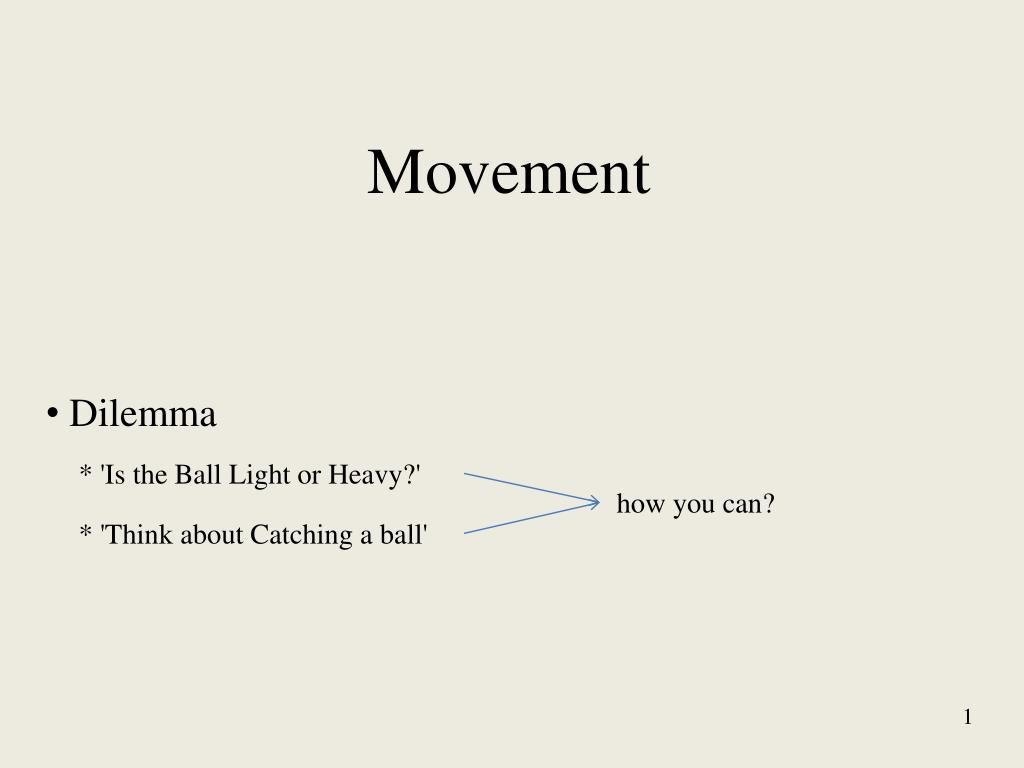
  1. Movement • Dilemma * 'Isthe Ball Light or Heavy?' how you can? * 'Think about Catching a ball'

  2. Nerve which follows Behavior * Lowest Extreme of Motor Hierarchy, in the Spinal Cord, Hundreds of Specialised Nerve Cells called Motor Neurons increase their Rate of Firing * Axons of these Neurons Project out to Muscles where they activate Contractile Muscle Fibers * Ca2+ Ions to be released from intracellular Stores inside each Muscle Fiber * This in turn Triggers Contraction of Muscle Fibers

  3. Nerve which follows Behavior * Electrical Events in Muscles of Arm can be recorded with an Amplifier, even through Skin(EMGs) * Motor Neurons are Final Common Path to Muscles that Move your Bones Moto r Cortex * Quite what is coded in Motor Cortex was Subject of a long Debate - Do Cells in Cortex Code for Actions that Person wants to Perform it * Strip of Tissue Running Across Surface of Brain - Nerve Cells that cause Movements in different Limbs are topographically arranged

  4. Basal Ganglia * Basal Ganglia are a Cluster of Inter connected Areas located Beneath the Cortex in Depths of Cerebral Hemispheres * Selecting Information from amongst the Enormous Numbers of Diverse Inputs they receive from Anterior Half of Cortex * Output of the Basal Ganglia feeds Back to Motor Cortical Areas * Precise Arrangement of Dopamine Axons onto their Target Neurons in Basal Ganglia is very intricate * You would need to Integrate Sensory Information into Stream of Signals Leading to your Muscles