Understanding Electric Fields: Potential Energy and Capacitance Explained
140 likes | 282 Vues
This educational overview explores the concepts of electric fields, electric potential, and energy storage. It explains how electric potential (ΔV) is defined by work done on a charge in an electric field and how electric potential energy is converted to kinetic energy when charges are in motion. The text analyzes problems related to calculating electric potential difference and field strength between charged plates. Additionally, it covers capacitors, their construction, capacitance computation, and practical applications in everyday electronics.


Understanding Electric Fields: Potential Energy and Capacitance Explained
E N D
Presentation Transcript
Energy and Electric Potential • As you lift an object off the ground, you are increasing its potential energy • Same is for electric potential • Electric potential (ΔV) • Work done moving a test charge in an electric field by dividing the magnitude of the test charge • ΔV = W / q (Work is the Potential energy need to remove the charge over some distance = joules) • Measured in joules /coulomb (J/C = Volt (V))
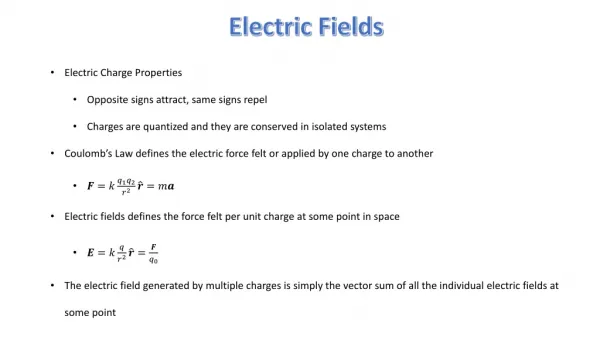
Electric Potential Energy • Work is required to push a charged particle against the electric field of a charged body. • EPE is the energy a charge particle possesses because of its location in an electric field. • If the particle is released it will accelerate away turning the EPE into kinetic energy.
Problem • If you apply 150 J of work to move a positive charge of 3.5 x 10⁻⁶ C from a negative plate, what is the electric potential difference? • Known • Work on q = 150 J • q=3.5 x 10⁻⁶ C • Unkown • ΔV • ΔV = W / q = 150 J / 3.5 x 10⁻⁶ C • =
Electric Potential • Electric Potential • Smaller when two unlike charges are closer together • Larger when two like charges are
Electric Potential in a Uniform Field • Uniform electric force and field made by placing 2 large conducting plates parallel to each other • Direction is from + plate to –plate • Potential difference, ΔV, between 2 points a distance (d) apart, in a uniform field (E) • ΔV = Ed
Problem • 2 Parallel plates are given opposite charges. A voltmeter measures the EPD to be 60.0 V. The plates are 3.0 cm apart. What is the magnitude of the electric field between them? • Known • ΔV = 60.0 V • D = 0.030 m • Unkown • E = ???
E = V / d • = 60.0 V / 0.030 m • = 2.0 x 10³ N/C
Storing Charges • Storing energy in an electric field • Leyden Jar • Developed by Dutch physicist Pieter Van Musschenbroek • Used by Ben Franklin to store charges from lightning • Version is still used today: Capacitor
Storing Charges: Capacitor • Ratio of charge stored to electric potential difference: called Capacitance, (C) • Capacitor designed to store electric charges and energy • Made of two conductors separated by an insulator • Capacitance = charge / electric potential difference • C = q / ΔV • Measured in Coulomb per volt (C/V) or 1 Farad (F)
Problem • A sphere has an eletric potential difference between it and Earth of 60.0 V when it has been charged to 3.0 x 10⁻⁶ C. What is the capacitance? • Known • V = 60.0 V • q = 3.0 x 10⁻⁶ • Unknown • C = ???
C = q / ΔV • = 3.0 x 10⁻⁶ / 60.0 V • = 0.00000005 F • = 0.05 µF
Capacitors • Examples: crank/shake flashlight, computer keyboards, flashes in cameras, electronics.