Normal Distribution
This guide delves into the essentials of normal distribution, including how to calculate the standard score (z-score) and the implications of the 68-95-99.7 rule. It explains the relationship between standard deviation and mean across various normal curves and identifies different distribution types, such as normal and bimodal. Additionally, it covers correlation and regression concepts, including interpreting scatter plots, calculating correlation coefficients, and understanding the relationship between correlation and causation. Practical tools for generating random numbers and statistical analysis using calculators are also discussed.

Normal Distribution
E N D
Presentation Transcript
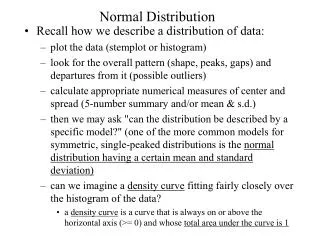
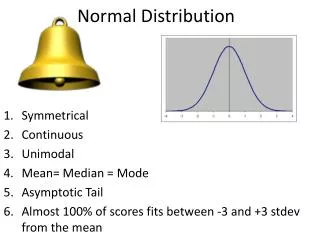
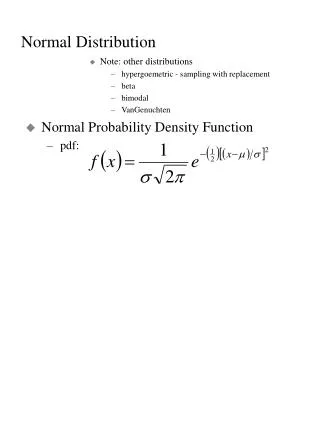
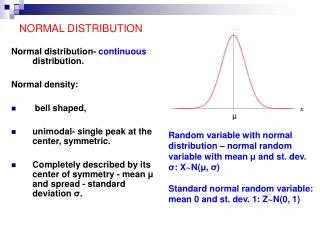
Normal Distribution • Calculate the Standard Score and calculate an observation from a standard score. • 68-95-99.7 rule • How StdDev and Mean relate to different normal curves • Kinds of things that will have different distributions: normal, uniform, bimodal, etc.
Correlation/Regression • Identify patterns scatter plots (form, direction, strength) • Correlation – how to calculate it and what it means. • The relationship between correlation and causation • R2 – how to calculate it and what it tells us • LSR – when do we use it (and when can’t we use it), how to tell when it is doing a decent job representing the data, • Interpreting the slope and y-intercept • Using LSR to predict
Calculator Stuff • Generating a list of random numbers using a random seed. • 123 -> rand thenRandInt(0, 1, 50) • Make a histogram/box plot or scatter plot • Stat Plot, pick your list, set your window • Find all the numbers for a 5-number summary • Stat then 1-var statistics • Calculate the mean and standard deviation • Same • Find the correlation, r2 and regression line • Stat then LinReg(ax+b)