Download
1 / 24
240 likes | 378 Vues
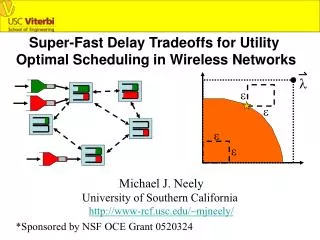
This study explores utility maximization in wireless networks with strict delay constraints. We focus on optimizing the timely throughput of clients, considering unreliable channels and specific delay bounds. The scenario includes multiple wireless clients and a single access point (AP), where packets must be delivered within their deadlines to avoid being dropped. We formulate the problem by decomposing it into client and access point subproblems, employing a bidding game for resource allocation. Our proposed scheduling policy, the Weighted Transmission Policy (WT), enhances overall utility while requiring no prior knowledge of channel conditions.

E N D
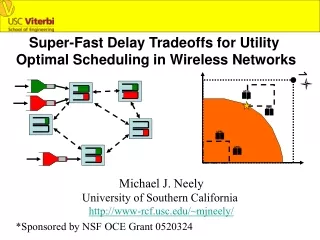
Utility Maximization for Delay Constrained QoS in Wireless I-Hong Hou P.R. Kumar University of Illinois, Urbana-Champaign
Problem Overview • Every packet has a hard delay bound • Timely throughput = Throughput of packets delivered within their delay bounds • qn = Timely throughput of client n • Un(qn) = Utility of client n • Channels are unreliable • Goal: Max ∑Un(qn) s.t. [qn] feasible under both channel unreliabilities and delay constraints • Example applications: VoIP, Network control, etc.
Client-Server Model • A system with N wireless clients and one AP • AP schedules all transmissions • Time is slotted 2 1 AP 3
Traffic Model • Group time slots into periods with τ time slots • Clients generate packets at the beginning of each period τ 2 1 AP 3
Delay Bounds • τ = Deadline • Packets are dropped if not delivered by the deadline • Delay of successful delivered packet is at most τ τ 2 1 arrival AP deadline 3
Channel Model • Each transmission takes one time slot • Links are unreliable • Transmission for client n succeeds with probability pn 2 p2 1 p1 AP p3 3
How the System Works F F S I S F S I 2 p2 1 p1 AP p3 F S S I 3
Timely Throughput • Timely throughput (qn) = F F S I S F S I 2 p2 1 p1 AP p3 F S S I 3
Problem Formulation • Each client has an utility function, • is strictly increasing, strictly concave, and continuously differentiable • AP needs to assign [qn] to maximize total utility, subject to feasibility constraints
Characterization of What is Feasible • The average number of time slots needed for client n to have timely throughput qn is • Let IS = Expected number of idle time slots when the set of clients is S • Clearly, we need • Theorem: the condition is both necessary and sufficient Average # of packets delivered in a period Average # of transmissions needed for a delivery
Optimization Problem • SYSTEM: • Decompose SYSTEM into two subproblems • CLIENTn: considers own utility function • ACCESS-POINT: considers feasibility constraints Utility functions may be unknown 2N feasibility constraints
Problem Decomposition CLIENTn: (Ψn given) Max over ACCESS-POINT: (ρn given) Max s.t. over
A Bidding Game Step 1. Each client n announces ρn Step 2. Given [ρn], AP finds [qn] to solve ACCESS-POINT Step 3. Client n observes qn, compute Ψn=ρn/qn. Client n finds new ρn to solve CLIENTn Step 4. Go to Step 2.
Solving ACCESS-POINT • ACCESS-POINT: (ρn given) Max s.t. over By KKT condition:
Solving ACCESS-POINT • ACCESS-POINT: (ρn given) By KKT condition: Average # of time slots working for client n per period
Solving ACCESS-POINT • ACCESS-POINT: (ρn given) By KKT condition: The more price paid, the more time slots received
Solving ACCESS-POINT • ACCESS-POINT: (ρn given) By KKT condition: Depends on prices paid by all clients and feasibility constraints (Difficult to solve)
Scheduling Policy for ACCESS-POINT • Weighted-Transmission Policy (WT): • 1. Let be the total number of time slots allocated for client n • 2. Sort clients by • 3. Clients with smaller get higher priorities • Theorem: WT solves the ACCESS-POINT problem • Require no knowledge on channel reliabilities
Simulation: Utility Maximization • Setup: • A set of 30 clients • Utility function: • Parameters: • Setting 1: • Setting 2: • Evaluate the mean and variance of
Evaluated Policies • WT policies and bidding game (WT-Bid) • WT policies without bidding game (WT-NoBid) • Randomly assign priorities (Rand) • Clients with larger get higher priorities, break ties randomly (P-Rand)
Simulation Results: Mean WT-Bid has highest total utility
Simulation Results: Variance WT-Bid has small variance
Conclusion • Formulate and solve the problem of utility maximization for delay-constrained wireless networks • Propose a scheduling policy to solve ACCESS-POINT τ CLIENTn arrival deadline SYSTEM Ψn ρn p2 1 p1 2 AP ACCESS-POINT
Thank You Another work on scheduling delay-constrained packets with time-varying channels, different delay bounds, and rate adaptation will be presented in TS60: WIRELESS NETWORK SCHEDULING 3