Download
1 / 8
80 likes | 207 Vues
Discover the fascinating characteristics of Mercury, Venus, Mars, Jupiter, Saturn, Uranus, and Neptune, the seven major planets in our solar system. From Mercury’s status as the smallest terrestrial planet to Jupiter’s massive size and Saturn’s iconic rings, each planet has its own unique features and intriguing facts. Learn about distances from the Sun, rotation and revolution periods, and the number of moons. Uncover the geological and atmospheric properties that distinguish these celestial bodies in our cosmic neighborhood.

E N D
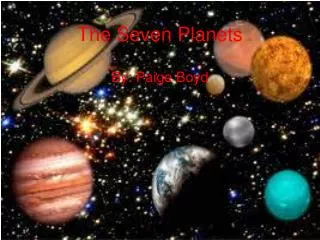
The Seven Planets By: Paige Boyd
Mercury • Mercury’s Equatorial Diameter in kilometers is 4,880 • The Average Distance to the Sun in AU’s is 0.39 • The Period of Rotation in Earth days is 59 • The Period of Revolution in Earth years is 0.24 • And Mercury has no moons • Facts: • 1: Smallest of the Terrestrial Planets • 2: Is Geologically Dead • 3: Is a dense planet with a very large iron core • 4: Closest Planet to the Sun • 5: Fastest-moving planet
Venus • Venus’s Equatorial Diameter in kilometers is 12,104 • The Average Distance to the Sun in AU’s is 0.72 • The Period of Rotation in Earth days is 243 • The Period of Revolution in Earth years is 0.62 • And Venus has no moons • Facts: • 1: Called the ‘evening star’ or the ‘morning star’ • 2: With exception of the moon it’s the brightest thing in the Earth’s night sky. • 3: Rotation rate is very slow • 4: 243 days just to rotate! • 5: Venus’s day is longer than it’s year
Mars • Mars’s Equatorial Diameter in kilometers is 6,794 • The Average Distance to the Sun in AU’s is 1.52 • The Period of Rotation in Earth days is 1.03 • The Period of Revolution in Earth years is 1.88 • Number of moons is 2! • Facts: • 1: Most Earthlike of all the planets • 2: Called the ‘red planet’ • 3: The surface of Mars is very old • 4: It once had many volcanic eruptions • 5: Olympus Mons on Mars is the largest volcano in the Solar System
Jupiter • Jupiter’s Equatorial Diameter in kilometers is 142,984 • The Average Distance to the Sun in AU’s is 5.20 • The Period of Rotation in Earth days is 0.41 • The Period of Revolution in Earth years is 11.86 • The number of moons is 50+ • Facts: • 1: First planet beyond the asteroid belt • 2: Named for the ruler of the Roman gods • 3: Is large enough to hold 1,300 Earth’s • 4: Largest and most massive planet in the Solar System • Composed mainly of Hydrogen and Helium
Saturn • Saturn’s Equatorial Diameter in kilometers is 120,536 • The Average Distance to the Sun in AU’s is 9.54 • The Period of Rotation in Earth days is 0.44 • The Period of Revolution in Earth years is 29.46 • Number if moons is 30+ • Facts: • 1: Second Largest planet in our Solar System • 2: Rings are the largest and most visible from Earth • 3: Rings are made of ice and ice-coated rock • 4: Rings are about 274,000 km in diameter • 5: Rings are only 10 meters thick
Uranus • Uranus’s Equatorial Diameter is 51,118 • The Average distance to the Sun in AU’s is 19.19 • The Period of Rotation in Earth days is 0.72 • The Period of Revolution in Earth years is 84.10 • Number of moons 20+ • Facts: • 1: Since its so far from the sun its very cold • 2: Atmosphere is mostly Hydrogen and Helium • 3: Atmosphere also has large amount of Methane • 4: Distinct blue-green appearance • 5: Lies nearly on its side
Neptune • Neptune’s Equatorial Diameter in kilometers is 49,528 • The Average Distance to the Sun in AU’s is 30.06 • The Period of Rotation in Earth days is 0.67 • The Period of Revolution in Earth years is 164.86 • Number of moons is 8+ • Facts: • 1: About the same size as Uranus • 2: Has clearly visible cloud patterns • 3: Clouds are made of methane ice crystals • 4: Bluish color comes from the methane in the atmosphere • 5: Has Large storms in its atmosphere