Download
1 / 6
60 likes | 180 Vues
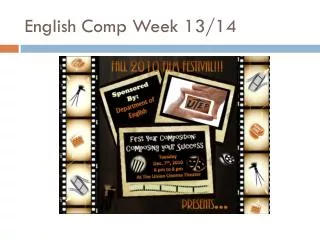
Attend the Documentary Film Festival on December 7th from 6-9 PM at the Union Cinema Theatre for an extra credit opportunity. Participate in a reflective analysis of the films presented, focusing on the authors' rhetorical strategies. Consider their thesis, the effectiveness of their ethos, pathos, and logos, and how these elements resonate with diverse audiences. Your one-page reflection will explore the relevance of these artifacts to contemporary issues and provide your take on their overall impact.

E N D
English Comp Week 4 Jorge gomez
Attendance Reflection 4 One PARAGRAPH
Film Festival Change Documentary Film Festival, Tuesday, Dec. 7th, 6-9 pm at the Union Cinema Theatre
Extra Credit Opportunity • Pat Mora, Sep. 16, 7-8pm, UGLC 106 • Lecture by fiction author DagobertoGilbOct. 6 at Tomas Rivera Center, Union East • 5:30 PM - 7:30 PM • Peace of Art exhibit and panel discussion: • Oct. 14 at the UTEP Union Cinema 6-7:30 pm • ONE-page Reflection after event for each to count
Rhet. Analysis Sample Structure • Introduce the Issue BRIEFLY • This is the CONTEXT • Introduce Artifact and Author of Artifact • What is the author’s thesis or purpose for writing/speaking? • What is she or he trying to ultimately prove? • State YOUR Thesis: Effective or ineffective rhetoric? • Why? Strong (ethos/pathos/logos) or Weak (pathos/ethos/logos) • Body of Paper: Analysis of ethos/pathos/logos • Which of the three were EFFECTIVE OVERALL and which INEFFECTIVE? • PARTS of each could be effective while WHOLE of each could be ineffective, and vice-versa • WHY? NEVER FORGET to state WHY. • Ethos includes RELEVANT bio and any conflict of interest (IF ANY) • Logos could INCLUDE fallacies (IF ANY) • In ANY order that fits. For example, • From weakest to strongest form of appeal or, • Strongest to weakest • Also, mention the AUDIENCES (remember, usually more than 1)
Rhet. Analysis Sample Structure • Do not worry about VISUAL rhetoric…not yet • This goes for people who chose videos to analyze • Conclude by summarizing YOUR paper • Include Relevance of issue to YOUR audience (peers) • Why does this rhetorical artifact matter? • In other words, “so what?” • “Food for thought” = closing thoughts on ISSUE • What can YOUR audience take from this ARTIFACT? • If it was effective, is it powerful enough to change minds? • If it was ineffective, is there something to learn about rhetoric from WHY it was ineffective? • Do I want your opinion on the issue?