Download
1 / 26
270 likes | 406 Vues
This document summarizes the R&D efforts on a scintillator-based muon detection system involving collaborations between Fermilab, Northern Illinois University, and other institutions. The project explores mechanical design concepts, optimizes detector parameters, and tests various scintillator materials, with a focus on wavelength shifting (WLS) fibers and photodetectors. Key experimental results from tests at Fermilab and discussions on muon identification and tracking algorithms are presented, highlighting the integration challenges with existing detector systems.

E N D
Scintillator Based Muon System R&D http://www-d0.fnal.gov/~maciel/LCD/awg_lcdmu.html Institutions/Collaborators Fermilab: A. Bross, B. Choudhary, H.E. Fisk, K. Krempetz, C. Milstene, A. Para, O. Prokovief, R. Stefanski Northern Illinois University: J. Blazey, D. Chakraborty, A. Dychkant, D. Hedin, A. Maciel, M. Martin Notre Dame University: M. Wayne UC Davis: M. Tripathi Wayne State University: P. Karchin Rice University: P. Padley, J. Matveev, J. Roberts University of Texas, Austin: K. Lang Contacts: P. Karchin, H.E. Fisk
Design Concepts • mID from penetration of the Fe yoke instrumented with scintillator planes; • Use the muon detector to measure shower leakage; CAL varies from 4 – 7l; • Similar to andetector, but….
R & D is Needed – Why? • How good is muon ID? For full LC menu? • Does E-flow benefit frommCal?. • Requires integration with barrel and forward tracking and calorimetry, structural Fe, solenoid, mechanical support, cables, etc. • Robust design parameters - must be understood, optimized, cost estimated, reviewed…. • Best m detector design?
Mechanical Engineering • Statics OK with 47T plates; • Bolting appears to be possible structurally. • Open questions: Machined Fe? Groove fitted? Spokes a la CMS? Bolted? Opportunities for further ME work here.
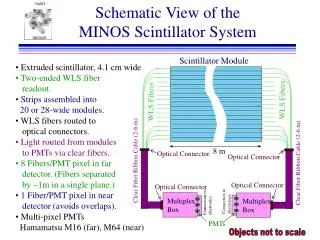
Scintillator Layout and Strips Scintillator: 4.1 X 1 cm2 co-extruded strips with 1 mm dia. WLS fiber and outer reflector of TiO2. U/V strips with wls shifted light exiting both ends. Add left/right signals from clear fibers to provide the pulse height sum.
Scintillator and PMT Studies • Hamamatsu H6568 MAPMTs loaned to us by MINOS. Wayne State => FE studies. • Scintillator testing at Fermilab in Lab 5 & NIU in prep. for scint. extrusion mach. NIU Test-stand for scintillator QC (Dychkant, Rykalin) Fermilab Lab 5 tests using VLPCs (Bross + Coop. Std.): 1.2, 1.0, 0.5 mm fiber preliminary results. • Setup of extrusion machine
Lab 5 at Fermilab Berstorff Extrusion Machine (purchased by NIU); being installed. First articles of scintillator in June.
Extruded Scintillator R&D at Fermilab • Studied Wavelength shifting (WLS) fiber readout of scintillator extrusions for possible future large scale detectors • Scintillator: MINOS extrusions • 1 X 4 cm – grooved • TiO2 reflector • Scintillator: KEK prototype • 1.2 X 2.5 cm – hole down the middle • TiO2 reflector • WLS: Kuraray Y11 • 1.2 mm 175 ppm (MINOS Standard) • 1.0 mm 200 ppm • 0.5 mm 200 ppm • Photodetector - Visible Light Photon Counter (VLPC) • Used D0 HISTE VI devices • QE=80-85% • Gain »60,000 Alan Bross – March 2003
VLPC Tests with MINOS Scintillator • 1.2 mm WLS fiber (MINOS) results using VLPCs. Tests of 1.0 & 0.5 mm fibers, etc. Want to try co-extr of scint + fiber. MINOS Ref. Value (sum) Alan Bross March2003
Barrel Ends Total WLS Fibers 51,200 42,766 93,966 187,932 Scintillator Area (m2) 7,174 4,353 9,527 Vol. (m3) 95.3 M(r=1.2g/cm3) 114.3T PM, Channel Count 16 channel multi-anode PM 30mm Clear Fibers Hamamatsu H6568
Multiplexing fibers • How many fibers onto a single pixel? • MINOS (1.2mm fiber) => 8 fibers/pixel • 128 fibers/MAPMT 188K fibers/128 fibers • 1500 MAPMTs • Needs study and a calibration scheme
Simulation Software Development/Studies • Development of LCD framework with GEANT4 simulation: Chakraborty, Maciel, Zutshi, Lima, students - Toward universal use; - Specific representations for Cal/Mu prototypes; - I/O compatibility with JAS & ROOT. • Development of muon (calorimeter) analysis code: Maciel, Markelof, Milstene • Muon ID & tracking algorithms: • Studies of single muons and pions • Comparison with TESLA studies • Studies of various final states. • We have looked only at SD muon geometry: detectors every 5 cm of Fe.
50 GeVp- event 11 run 0 EyeFish View-18 hits in Muon Detector
Tracking Algorithm Development Use the basic algorithm developed by M. Piccolo : compare the muon candidate hits with the track extrapolated from central tracking. Use Dq and Dj cuts in doing the matching. Study: Pion punch-through vs momentum (>80cm m Fe) using a simple algorithm – 16 or more hits in 16 or more gaps in m system with (Dq , Dj)m < (2,2) bins where ea. bin is 21 mr; (Dq , Dj)Hcal < (1,3) 5.2 mr. Remove p decays (less than 1% for pm > 3 GeV). Find punch-through reaches about 1.5% at 50 GeV. Smaller if one vetoes a track with 5 planes having g.e. 2 hits; i.e. hadron-like candidate in the muon detector. C. Milstene/M. Piccolo
Pion Punch-through • The response to p • reported for 35000 events (Tesla) • By M . Piccolo has been Reproduced Theblue diamonds represent The SD • Points for p after • Normalization to account for the • Difference in interaction length • and statistics • TheGreen stars • Correspond to an • Extra cut: • Vetoing when 5 planes have >=2 hits 10/700 = 1.4% Preliminary Result
Improved low momentum muon ID Inspection of the (Dq , Dj) distributions as a function of pm showed asymmetric and skewed distributions. This was traced to a an omission of dE/dx in the projection of central tracks into the calorimeter and muon systems. Fixing this problem has significantly improved the matching efficiency for low momentum muons, 3 to 6 GeV/c. e.g. eff in the 4 GeV bin moves from from 0.7 to 0.95 C. Milstene
Muon ID with dE/dx Correction Preliminary Result
More to Do! • Muon ID in jets may be possible. We need to look. • Lack of progress on the muon system’s use as a calorimeter – potentially important. • Need advances in improved simulation software for planar detectors. • Need to investigate utility of a set of (wire?) chambers between the solenoid and the muon Fe. • How to handle and calibrate 188K channels? • We lack personnel! More magnetism?
Wayne State: Paul Karchin - PMT studies, FE electronics specs, prototype electronics, physics studies. Needs funding for MAPMTs, (wo)manpower, travel. UC Davis: Mani Tripathi - Readout electronics, use existing RO to learn the important parameters. Needs input from Wayne State; needs money to involve others and travel to Fermiab. NIU: Arthur Maciel – Dhiman Chakraborty – the next generation of simulation software; generation/maintenance of SIO library files. Sasha Dychkant/Vicor Rykalin scintillator development and testing. Can pay for student help with UCLC funding! Notre Dame: Mitch Wayne fiber expert; has manpower if he can pay for it – needs funding. The ALC Muon Collaboration • Fermilab: There is a lot to do and we lack manpower!
MINOS Scintillator Measured light output using the complete MINOS optical system: Connectors, clear fibers, multi-anode PMT’s Number of observed photoelectrons Distance along the module (m) Near 11±3 p.e. Far (3.6 m for the proposed layout) 6±2 p.e.