
Network Layer Design Issues: Packet Switching and Routing Algorithms
E N D
Presentation Transcript
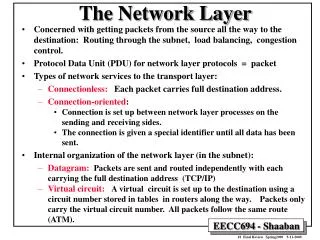
The Network Layer Chapter 5
Network Layer Design Isues • Store-and-Forward Packet Switching • Services Provided to the Transport Layer • Implementation of Connectionless Service • Implementation of Connection-Oriented Service • Comparison of Virtual-Circuit and Datagram Subnets
Store-and-Forward Packet Switching fig 5-1 The environment of the network layer protocols.
Implementation of Connectionless Service Routing within a datagram subnet.
Implementation of Connection-Oriented Service Routing within a virtual-circuit subnet.
Routing Algorithms • The Optimality Principle • Shortest Path Routing • Flooding • Distance Vector Routing • Link State Routing • Hierarchical Routing • Broadcast Routing • Multicast Routing • Routing for Mobile Hosts • Routing in Ad Hoc Networks
Routing Algorithms (2) Conflict between fairness and optimality.
The Optimality Principle (a) A subnet. (b) A sink tree for router B. If J is on the path from I to K then the path from J to K follows the same route.
Shortest Path Routing The first 5 steps used in computing the shortest path from A to D. The arrows indicate the working node.
Flooding 5-8 top Dijkstra's algorithm to compute the shortest path through a graph.
Flooding (2) 5-8 bottom Dijkstra's algorithm to compute the shortest path through a graph.
Distance Vector Routing (a) A subnet. (b) Input from A, I, H, K, and the new routing table for J.
Distance Vector Routing (2) The count-to-infinity problem.
Link State Routing Each router must do the following: • Discover its neighbors, learn their network address. • Measure the delay or cost to each of its neighbors. • Construct a packet telling all it has just learned. • Send this packet to all other routers. • Compute the shortest path to every other router.
Learning about the Neighbors (a) Nine routers and a LAN. (b) A graph model of (a).
Measuring Line Cost A subnet in which the East and West parts are connected by two lines.
Building Link State Packets (a) A subnet. (b) The link state packets for this subnet.
Distributing the Link State Packets The packet buffer for router B in the previous slide (Fig. 5-13).
Hierarchical Routing Hierarchical routing.
Congestion Control Algorithms • General Principles of Congestion Control • Congestion Prevention Policies • Congestion Control in Virtual-Circuit Subnets • Congestion Control in Datagram Subnets • Load Shedding • Jitter Control
Congestion When too much traffic is offered, congestion sets in and performance degrades sharply.
General Principles of Congestion Control • Monitor the system . • detect when and where congestion occurs. • Pass information to where action can be taken. • Adjust system operation to correct the problem.
Classification of Congestion Control Open Loop Congestion Prevention Closed Loop Explicit Feedback Implicit Feedback
Congestion Control in Virtual-Circuit Subnets • A congested subnet. (b) A redrawn subnet, eliminates congestion and a virtual circuit from A to B. • The point: can do admission control; congestion prevention
Hop-by-Hop Choke Packets (a) A choke packet that affects only the source. (b) A choke packet that affects each hop it passes through. The point: have to respond to conditions with feedback mechanism
Explicit Feedback • Congestion warning bit – fed forward to recipient who fed it back to the sender (DECnet) • Choke packets • What should the sender do when it receives congestion feedback? A thorny question!
Implicit Feedback • Routers drop packets • Packets are delivered slowly • Sender responds to missing acks or delayed acks by slowing sending rate • Again, what is a good response? • For performance of this flow? • For overall performance of the network?
Quality of Service • Requirements • Techniques for Achieving Good Quality of Service • Integrated Services • Differentiated Services • Label Switching and MPLS
Requirements 5-30 How stringent the quality-of-service requirements are.
Jitter Control (a) High jitter. (b) Low jitter.
Buffering to reduce jitter Smoothing the playback stream by buffering packets.
The Leaky Bucket Algorithm (a) A leaky bucket with water. (b) a leaky bucket with packets.
The Leaky and Token Bucket Algorithms (a) Input to a leaky bucket. (b) Output from a leaky bucket. Output from a token bucket with capacities of (c) 250 KB, (d) 500 KB, (e) 750 KB, (f) Output from a 500KB token bucket feeding a 10-MB/sec leaky bucket.
The Token Bucket Algorithm 5-34 (a) Before. (b) After.
Admission Control 5-34 An example of flow specification.
Integrated Services Convergence of data and audio networks From the IETF perspective From the telephony perspective Economic and technical issues Reserved resources in packet-oriented network Per-flow state in routers Advance setup Scalability
Differentiated Services • Tag packets at network ingress with class of service • Example: expedited forwarding – some packets get better service than others • “Network Neutrality”
Expedited Forwarding Expedited packets experience a traffic-free network.
Label Switching and MPLS Transmitting a TCP segment using IP, MPLS, and PPP.
The Network Layer in the Internet • The IP Protocol • IP Addresses • Internet Control Protocols • OSPF – The Interior Gateway Routing Protocol • BGP – The Exterior Gateway Routing Protocol • Internet Multicasting • Mobile IP • IPv6
Design Principles for Internet • Make sure it works. • Keep it simple. • Make clear choices. • Exploit modularity. • Expect heterogeneity. • Avoid static options and parameters. • Look for a good design; it need not be perfect. • Be strict when sending and tolerant when receiving. • Think about scalability. • Consider performance and cost.
The IP Protocol The IPv4 (Internet Protocol) header.
The IP Protocol (2) 5-54 Some of the IP options.
IP Addresses IP address formats.
IP Addresses (2) Special IP addresses.
Subnets A campus network consisting of LANs for various departments.
Subnets (2) A class B network subnetted into 64 subnets.
CDR – Classless InterDomain Routing 5-59 A set of IP address assignments.