SlideServe
Menu
Préférences
© SlideServe · v2026

Femtoscopy Theory: Deriving Fundamental Formula & Identical Particles Phenomenon

mclemmer avatar
30 diapositives · 338 Views · Jan 03, 2020

Explore the theory of femtoscopy by Scott Pratt from Michigan State University, focusing on deriving the fundamental formula, identical particles behavior, and using correlations to understand space-time evolution. Learn about phase space cloud measurements, hadronic interferometry, and the impact of identical particles on measuring lifetime and shape. Discover the implications in strong interactions, Coulomb interactions, and phase transitions at RHIC.
Femtoscopy Theory: Deriving Fundamental Formula & Identical Particles Phenomenon - slide 1
01 / 30Femtoscopy Theory: Deriving Fundamental Formula & Identical Particles Phenomenon
1 / 17

Télécharger la présentation

Femtoscopy Theory: Deriving Fundamental Formula & Identical Particles Phenomenon
Une image / un lien ci-dessous est fourni (tel quel) pour télécharger la présentation

Politique de téléchargement : le contenu du site vous est fourni TEL QUEL pour votre information et votre usage personnel ; il ne peut être vendu, concédé sous licence ni partagé sur d’autres sites sans l’accord de son auteur.Le contenu vous est fourni TEL QUEL, pour votre information et votre usage personnel uniquement. Téléchargez la présentation en cliquant sur ce lien. Lors du téléchargement, si vous ne parvenez pas à télécharger une présentation, l’éditeur a peut-être supprimé le fichier de son serveur.Pendant le téléchargement, si vous ne parvenez pas à obtenir une présentation, le fichier a peut-être été supprimé par l’éditeur.

F I N

Plus de contenu associé

Transcription de la présentation
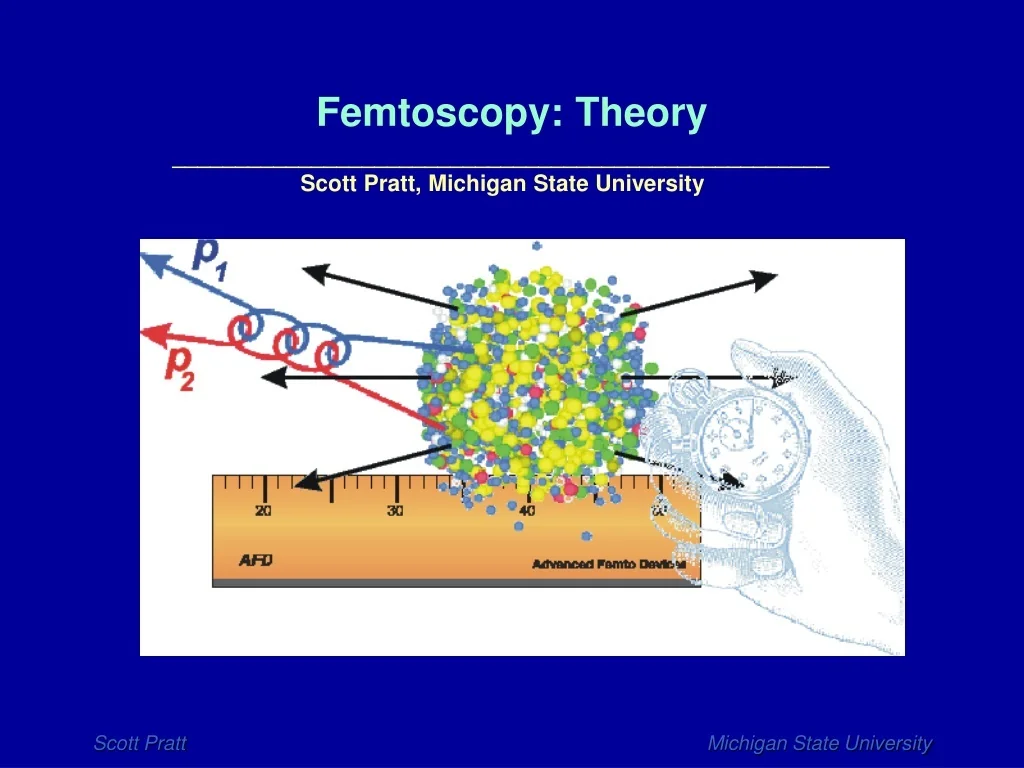
  1. Femtoscopy: Theory ____________________________________________________ Scott Pratt, Michigan State University Scott Pratt Michigan State University

  2. Deriving the Fundamental Formula Scott Pratt Michigan State University

  3. Deriving the Fundamental Formula Step 1: Define the source function Scott Pratt Michigan State University

  4. Deriving the Fundamental Formula Step 2: Write 2-particle probability = probability relative momentum q and separation x evolves to q asymptotically Scott Pratt Michigan State University

  5. Deriving… Identical particles Smoothness approximation Scott Pratt Michigan State University

  6. With final-state interactions Approximate (in frame of pair), Smoothness approximation Scott Pratt Michigan State University

  7. Deriving… Summary Assumptions • Strong/Coulomb • Independent emission • Ignore time differencefor evolution • Smoothness • Identical Particles • Symmetrize pairwise • Independent emission • Smoothness * * * * Tested Scott Pratt Michigan State University

  8. Femtoscopy – Theory • Measures phase space cloud for fixed velocity • Overall source can be larger • Inversion depends on|f(q,r)|2 Scott Pratt Michigan State University

  9. Hadronic Interferometry – Theory Theories predict SP(r) C(P,q) Correlations provide stringent test of space-time evolution Scott Pratt Michigan State University

  10. Using Identical Particles • Examples: pp, KK, … • Easy to invert • 3-dimensional information • Rout, Rside, Rlongare functions of P Scott Pratt Michigan State University

  11. Identical Particles: Measuring Lifetime • Has been studied for pp, KK, pp, nn • Source function S(p,r,t) is 7-dimensional– requires one dimension of common sense Scott Pratt Michigan State University

  12. d-a Correlations Strong Interactions G. Verde / MSU Miniball Group DE (MeV) • Peak height determined by scattering length or resonance width • Examples: pp, pL, nn, pp, Kp, pa, da, … Scott Pratt Michigan State University

  13. Can be calculated classically for larger fragments Kim et al., PRC45 p. 387 (92) Coulomb Interactions Scott Pratt Michigan State University

  14. S.Panitkin and D.Brown, PRC61 021901 (2000) Proton-protonCorrelations Deconvoluting C(q) provides detailed source shape Scott Pratt Michigan State University

  15. Measuring shape without identical particles Scott Pratt Michigan State University

  16. Example: pK+ correlations Gaussian Sources: Rx=Ry=4, Rz=8 fm Scott Pratt Michigan State University

  17. Simple correspondence! Danielewicz and Brown Detailed Shape Information Standard formalism: Defining, Using identities for Ylms, Scott Pratt Michigan State University

  18. L=0 • L=1, M=1 • L=2, M=0,2 • L=3, M=1,3 Angle-integrated shape Moments Lednicky offsets Shape (Rout/Rside, Rlong/Rside) Boomerang distortion Scott Pratt Michigan State University

  19. Blast Wave Model • (z  -z) CL+M=even(q) = 0 • (y -y) Imag CL,M = 0 Scott Pratt Michigan State University S.P. and S.Petriconi, PRC 2003

  20. Liquid-Gas Phase Transition Definition of Gas: “Expands to fill available volume” Liquid = Evaporation  Long lifetimes Gas = Explosion  Short lifetimes Scott Pratt Michigan State University

  21. Change to Explosive Behavior (GAS) at ~ 50 AMeV Scott Pratt Michigan State University

  22. Experimental Signatures Dramatic change in nn correlations t ~ 50 fm/c t ~ 500 fm/c Scott Pratt Michigan State University

  23. Phase Transition at RHIC • Transparency complicates the problem • For complete stopping, times could be ~ 100 fm/c • For Bjorken, strong first-order EOS leads to t ~ 20 fm/c Scott Pratt Michigan State University

  24. Phase Transition at RHIC? Stiffer EOS -> Smaller source sizes Data demonstrate no latent heat or significant softness Scott Pratt Michigan State University

  25. THE HBT PUZZLE AT RHIC To fit data: a) Stiff (but not too stiff) EOS b) Reduce emissivity from surface c) Not that much different than SPS Scott Pratt Michigan State University

  26. Any method to extract Rinv is sufficient Phase space density Scott Pratt Michigan State University

  27. Phase space density <f> rises until threshold of chemical equilibrium mp ~ 80 MeV at break-up Scott Pratt Michigan State University

  28. HBT and Entropy Entropy can be determined from average Phase space density • <f> determined from: • correlations (pp) • coalescence (KKf,ppd) • thermal models… Scott Pratt Michigan State University

  29. hydro eBjorken Entropy for 130 GeV Au+Au at t = 1 fm/c S.Pal and S.P., PLB 2003 Scott Pratt Michigan State University

  30. Summary • Correlations CRUCIAL for determining • Pressure • Entropy • Reaction Dynamics Scott Pratt Michigan State University