The Impact of Urbanization on Early American Cities (1890-1910)
Early urbanization in America transformed cities into bustling centers of trade and industrialization, driven by advances in transportation and electricity, particularly in the Northeast and Midwest. Immigrants flocked to these cities for jobs, leading to crowded housing and significant social challenges, including inadequate sanitation, rampant disease, and crime. While settlement houses aimed to aid immigrant families, political machines often perpetuated corruption. As a response, reformers sought a civil service system to curb these issues, gaining ground with acts like the Pendleton Civil Service Act.

The Impact of Urbanization on Early American Cities (1890-1910)
E N D
Presentation Transcript
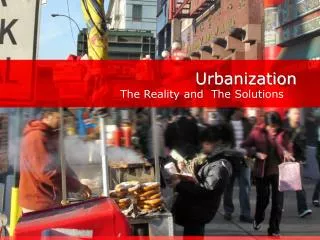
Urbanization Standard 4.5
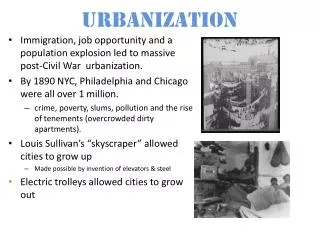
Early Growth of Cities • began as centers of trade; most at major harbors/waterways • transportation advances made them hubs • electricity made them centers of industrialization mainly in Northeast & Midwest
Immigrants • flooded cities because it was cheap • many jobs for unskilled labor • Americanization movement: designed to assimilate immigrants; govt-sponsored; taught literacy, history, etiquette • most did not assimilate; settled in ethnic neighborhoods
Migrants • mechanization meant fewer jobs for people • most farmers w/o jobs were blacks; 200,000 moved north 1890-1910 • some moved North to escape discrimination, segregation • competition for jobs heightened racial tensions
City Problems • crowded housing (row houses, tenements) • mass transit in need of repair • water was unfit to drink; most homes lacked indoor plumbing • sanitation not in place until 1900 • crime & disease rampant • fire spread quickly
Responses to City Problems • settlement houses: begun to help families adjust to life in America; Jane Addams’ Hull House (Chicago) was most famous • city planning to allow for green spaces • political machines: groups that controlled the politics of one party in a city; run by a boss; helped immigrants learn the political process & with naturalization
Problems with Machines • led to corruption; many people got paid to vote multiple times • graft: personal gain because of political influence (getting kickbacks)
Tweed Ring • William Tweed led Tammany Hall (Dem. machine in NYC) • received $10 million in graft from construction of NY County Courthouse • Thomas Nast: exposed Tweed Ring through political cartoons • Tweed jailed on 120 counts of fraud & extortion for 1 year
Response to Machines • patronage leading to vast corruption; also known as the ____________ system • reformers wanted a civil service system; get your job because you’re qualified • President James Garfield assassinated 1881 by someone denied a job • Pendleton Civil Service Act: 1883; est. civil service commission; ended patronage
Proof of Learning 3/21 • Why did many blacks move to Northern cities between 1890 and 1910? • How did tenements contribute to the threat of fire & spread of disease in cities? • Why were settlement houses begun? Which one was most famous? • Why were political machines a problem? Name the leader of the most famous one. • How did the Pendleton Act attempt to end political corruption?
New Immigration Standard 4.5
“Old” Immigrants • pre-Civil War • from Western Europe • assimilated faster • literate • skilled • mainly Protestant
“New” Immigrants • Gilded Age • from Eastern, Southern Europe & Asia • spoke Slavic languages • did not assimilate; formed ethnic neighborhoods • unskilled • illiterate • many Catholics, Jews • entered at Ellis Island (east), Angel Island (west)
Ethnic Neighborhoods • immigrants segregated themselves • areas resembled homelands; Chinatown, Little Italy, Greektown, Polonia • spoke native languages, cooked ethnic foods, established immigrants helped the “newbies”
Getting into the Country • traveled in steerage for 1-3 weeks • processing was an ordeal—delousing, general disinfection, literacy test, cruel officials • many names changed; many turned away
Nativism • new immigrants challenged “melting pot” idea; people are not abandoning old culture to become American • wanted to be Italian (or something) living in America • nativism: belief that America should be preserved for native-born white Americans; believed new imms. lacked drive & work ethic
Immigration Restrictions • literacy test: law attempted in 1897; had to be able to read 40 words in English or native lang.; vetoed by Pres. Cleveland • Chinese Exclusion Act: 1882-1943; no unskilled imms.; only tchrs, merchants, tourists, govt officials allowed in • Gentlemen’s Agreement: 1907; T. Roosevelt agreed to desegregate San Francisco if Japan quit sending unskilled workers to US
Proof of Learning 3/22 • Name 2 ways New Immigrants differed from Old Immigrants that made it difficult for them to assimilate. • How did ethnic neighborhoods help immigrants settle in the US? • What is nativism? • How did the Chinese Exclusion Act & Gentlemen’s Agreement help US workers? • Should the US be a melting pot or a tossed salad? Explain your answer.
Progressivism 1900-20 Standard 4.6
How it started • rapid industrialization, urbanization • bad working & living conditions • Populist ideas • rise of mass culture, leisure time gave people ability to care • goals: return control of govt to the people; restore economic opportunities; correct injustices in American life
big business corruption political corruption cleanliness of food economy/taxes Prohibition labor education women’s rights civil rights conservation Major concerns
Muckrakers • people who exposed corruption in various aspects of life • Upton Sinclair: wrote The Jungle; exposed nasty state of food production • Ida M. Tarbell: exposed ruthlessness of John Rockefeller
Theodore Roosevelt • aka “Teddy” (Mrs. McCuen’s other favorite) • president 1901-09; elected Republican; became Progressive (Bull Moose Party) • big on conservation; expanded national park system • Pure Food & Drug Act: passed in reaction to reading The Jungle • known as a “trustbuster”
Political Reforms • initiative: bill originated by the people • referendum: people vote on initiative • recall: remove elected officials from office • 16th Amendment: 1913; allowed federal income tax • 17th Amendment: 1913; direct election of Senators
More laws • 18th Amendment: 1919; Prohibition of alcohol; repealed 1933 by 21st Am. • 19th Amendment: 1920; women’s suffrage • Clayton Antitrust Act: 1914; made unions exempt from anti-trust laws • child labor eventually banned; resulted in need for more _______________
Federal Reserve Act (1913) • allowed more flexibility in money supply; helped the farmers • divided nation into 12 regions; central bank in each region • Federal Reserve Banks are where banks do their banking; could issue more paper currency, make loans to save banks
Civil Rights • led by WEB DuBois; at odds w/Booker T. Washington • BTW wanted gradual acceptance; earn respect by proving worth (made bricks) • DuBois wanted immediate equality b/c Constitution demanded it; began NAACP w/Niagara Declaration of Principles
Proof of Learning 3/25 • What were the goals of progressivism? • What role did muckrakers play in the movement? • How did initiative, referendum, & recall advance the goals of progressivism? • Which Amendment (16-19) was most necessary to the progressive cause? Why? • Whose approach to civil rights would have been accepted in the South? Why?